

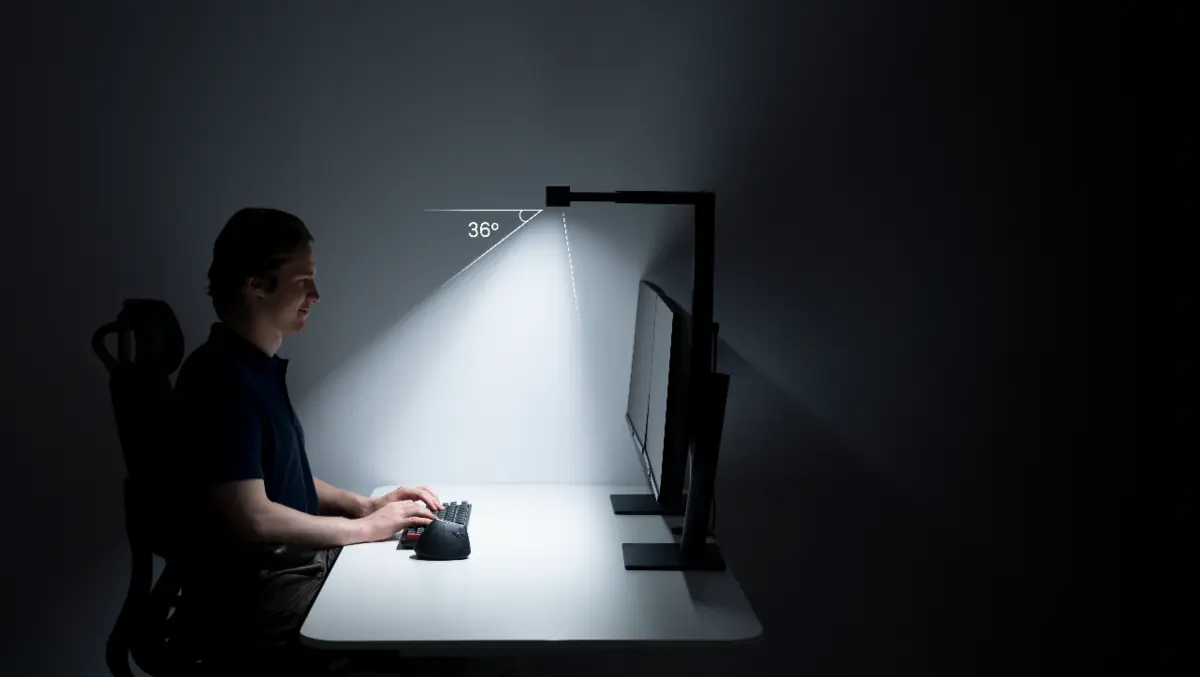
BenQ adds ScreenBar Max & iScreenBar for workspaces
Fri, 28th Aug 2026
BenQ has added the ScreenBar Max and iScreenBar to its ScreenBar lighting range, targeting dual-monitor and iMac users.
The ScreenBar Max is aimed at people working across two displays, while the iScreenBar is designed for Apple's iMac desktop computers. BenQ said the additions expand its screen-mounted lighting line as workplace setups become more specialised.
BenQ positioned the ScreenBar Max as a desk lamp for multi-screen environments such as coding, financial analysis and other data-heavy work. It said the lamp delivers desktop illumination of more than 1400 lx and uses what it calls an ASYM-TriZone Light optical system to direct light across horizontal, vertical and curved monitor arrangements.
The unit includes a 36-degree shielding angle intended to reduce glare during extended use. It also has an ambient backlight designed to soften the contrast between bright screens and darker surroundings, along with automatic adjustment of up to 700 lx based on surrounding light conditions.
Its design is intended to sit above the monitor rather than take up desk space, reflecting demand for less cluttered workstations. BenQ also said the ScreenBar Max has received a 2026 Red Dot Design Award.
By contrast, the iScreenBar is focused on a single hardware ecosystem. BenQ said it was made specifically for iMac users and built from CNC-machined aluminium alloy to match the appearance and layout of Apple's desktop range.
It uses the ASYM-Light optical structure already found in the ScreenBar series, which BenQ said allows it to light the desk area without reflecting on the screen. The iScreenBar also includes auto-dimming and a magnetic attachment system for installation and repositioning.
BenQ said the product is intended for creative professionals who need to preserve screen clarity and colour accuracy. It also includes a Video Call Mode designed to improve facial lighting during online meetings.
A separate macOS application extends the iScreenBar's controls, allowing users to set different brightness and colour temperature preferences for individual applications. BenQ said the light can then adjust according to the active workflow.
Workplace focus
The launch reflects a broader push by device makers to adapt peripherals and workspace accessories to more varied office and home working arrangements. Lighting has become a more visible part of that market, particularly for workers who spend long periods in front of screens or move between different display formats.
BenQ framed the additions as part of a wider effort to tailor lighting to distinct work environments rather than offer a single general-purpose product. One device is centred on multi-monitor productivity, while the other is built around a specific desktop computer platform and its users.
JC Pan, head of the Digital Lifestyle Products Business Unit at BenQ, said: "We have continually evolved the ScreenBar Series in response to how people interact with modern workspaces, guided by our commitment to human-centric lighting and visual well-being. Our smart lighting philosophy is grounded in scientific research, lab-based validation, and real-world behavioral insights, ensuring that each iteration delivers measurable performance and a meaningful user experience. As work environments become more dynamic, we remain focused on lighting solutions that enhance comfort and seamlessly integrate into the future of work."
Pricing and range
In Australia, the ScreenBar Max will retail for AUD $489 and the iScreenBar for AUD $229. BenQ said the silver version of the iScreenBar will launch alongside the ScreenBar Max, with green and blue versions to follow later.
The iScreenBar has also received design recognition, with BenQ saying it won both a 2026 iF Design Award and a Red Dot Design Award. Those honours place it alongside the ScreenBar Max as BenQ seeks to strengthen the design credentials of its workspace accessories as well as their functional role.
BenQ, which has more than 30 years of experience in display technologies, sells products across digital lifestyle, business, healthcare and education markets. Its wider portfolio includes monitors, projectors, commercial displays, gaming equipment and remote work tools.
The two additions underline how peripheral makers are increasingly segmenting products around specific use cases and user groups, rather than broad office lighting needs.