

Logitech unveils pro AV speakers for large meeting rooms
Fri, 9th Oct 2026 (Today)
Logitech has introduced the Rally Speaker 2 Pro and Rally Speaker 2 Max for large conference rooms and training spaces, marking its entry into the professional audiovisual market.
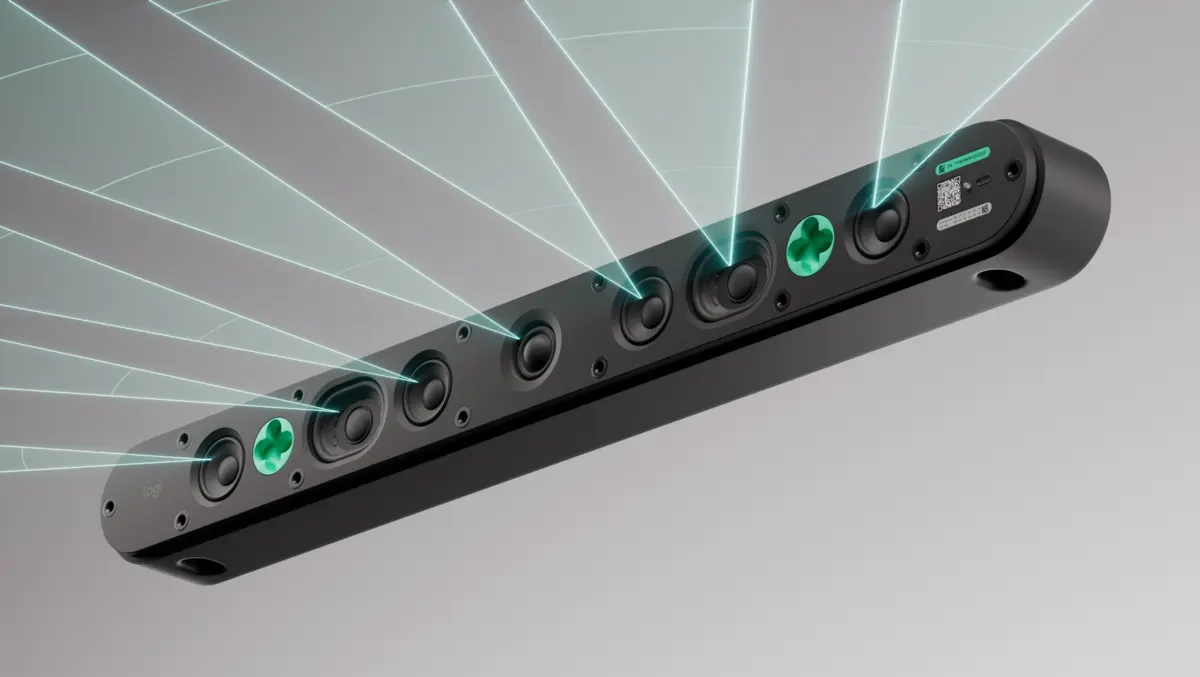
The two front-of-room speaker systems use Logitech's Sound Shape technology, which directs audio to defined listening areas rather than dispersing it broadly around a room. The approach is aimed at extra-large meeting rooms, executive boardrooms and divisible training spaces, where sound coverage can be uneven.
The products are part of Logitech's biggest enterprise launch to date. The company says conventional ceiling speakers can be expensive to install and wire, and often project voices from positions that do not align with the speaker at the front of the room.
Rally Speaker 2 Pro includes an array of 32 micro-drivers in a single soundbar, while Rally Speaker 2 Max extends coverage with 64 drivers. Logitech says the systems manage sound waves to reinforce audio in target areas and reduce it where it is not wanted.
According to Logitech, the technology can deliver more consistent volume from the front to the back of a room than standard speaker setups. In a 12-metre room, the drop in sound level is limited enough to make volume feel nearly the same across the space.
Sound targeting
Logitech positions the system as an alternative to raising room-wide volume to reach listeners at the back. Instead, the speakers are designed to send concentrated beams of sound toward specific seating zones while reducing reflections from walls and ceilings.
The concept is central to Logitech's attempt to stand out in a segment that has typically relied on distributed ceiling audio, wall-mounted speakers and more complex installation work. By keeping speakers at the front of the room, the company is presenting the products as a simpler option for organisations fitting out larger collaboration spaces.
"Today, we cross the boundary from science fiction into a bold new era of human interaction," said Karthik Rajagopal, Head of VC Engineering at Logitech.
"We've replaced the brute-force approach of cranking up room volume with wave-field physics - essentially steering sound waves through open air with surgical precision," Rajagopal said.
Multilingual use
Logitech also outlined an early-stage multilingual application for the Rally Speaker 2 Max. The system can aim two separate audio feeds at opposite sides of the same room, allowing different groups to hear different spoken languages at the same time.
This could be used in international meetings, cross-border negotiations and training sessions where participants need separate language feeds without installing different speaker systems in each area. Logitech says it is working with partners to integrate the concept with Interpreter in Microsoft Teams meetings and Voice Translator in Zoom meetings.
The proposal reflects a growing focus among workplace technology suppliers on hybrid and multilingual collaboration tools, particularly for global companies trying to reduce friction in international meetings. Audio has often been a weaker link in those environments, especially in larger rooms where speech intelligibility drops as participants move farther from the source.
Logitech has long been known for peripherals and video collaboration equipment, and the new range broadens its presence in meeting-room infrastructure. Its entry into the Pro AV market places it in closer competition with specialist audio and room-systems suppliers serving corporate and institutional customers.
For buyers, the commercial test is likely to centre on whether a front-mounted system can match or exceed the coverage of conventional distributed audio in large rooms while reducing installation complexity. The multilingual application may also draw interest if organisations can support interpretation in the same room without headsets or separate breakout areas.
"The international boardroom of the future isn't about finding a single universal dialect-it's about translation coexisting in the same acoustic space. Sound Shape unlocks big potential for cross-border diplomacy, global M&A negotiations, and multi-regional training environments," Rajagopal said.