

Grafana Labs named leader in Gartner observability report
Thu, 16th Jul 2026
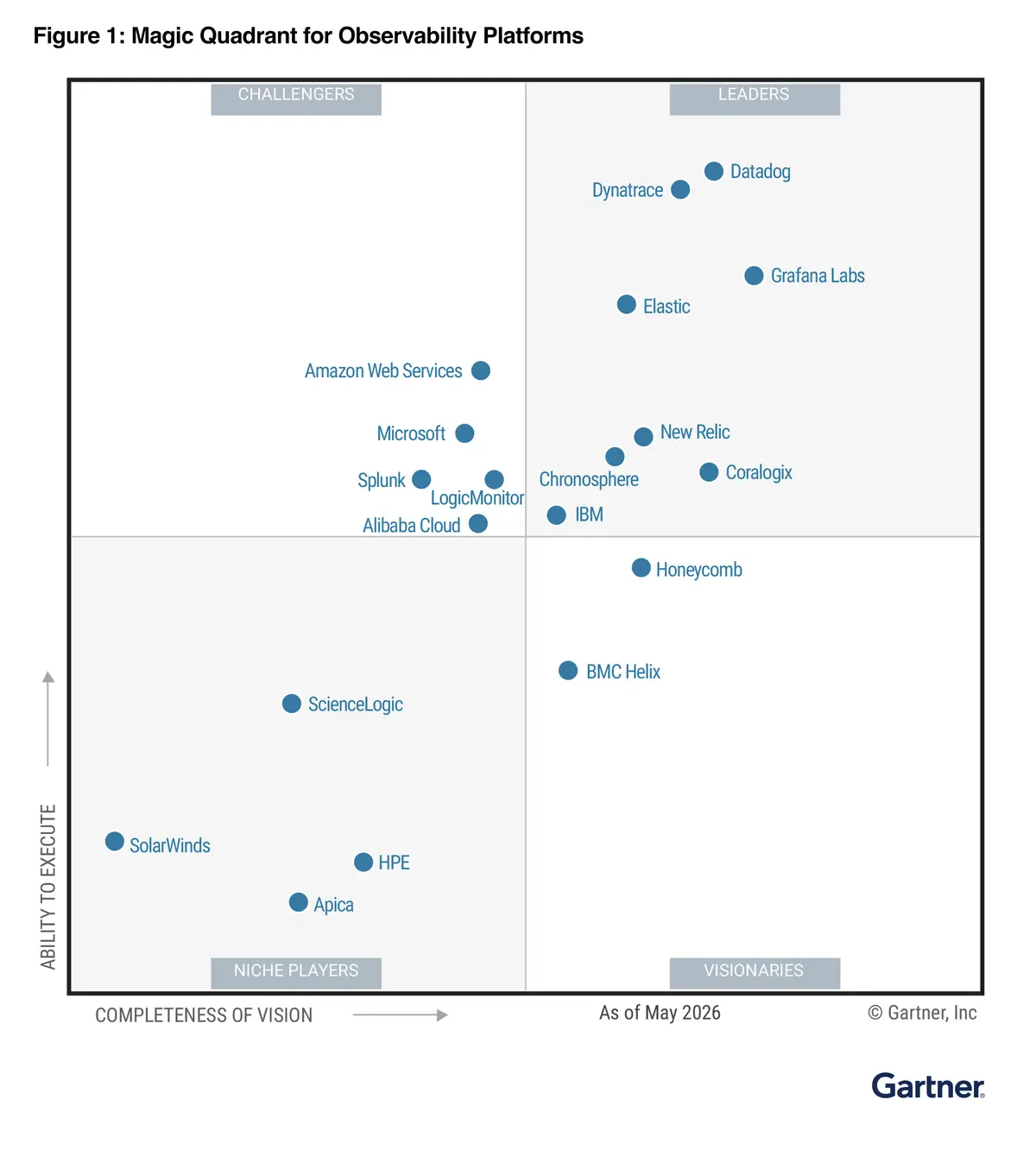
Grafana Labs has been named a Leader in the 2026 Gartner Magic Quadrant for Observability Platforms and placed furthest on the Completeness of Vision axis.
The ranking marks the third consecutive year Grafana Labs has been named a Leader in the report and the second straight year it has been positioned furthest for vision.
Observability software helps companies monitor applications, infrastructure, and digital services. The category has taken on greater importance as businesses deploy artificial intelligence systems in production. Grafana Labs said this shift in demand reflects the operational strain created by larger volumes of telemetry data, more distributed systems, and the need to track the behaviour of AI models and agents alongside traditional software infrastructure.
The New York-based group said it expanded its Grafana Cloud platform over the past year to address those pressures. Additions include Grafana Assistant, a conversational AI feature designed to answer questions about systems using existing telemetry data, and Assistant Investigations, which correlates alerts and surfaces likely root causes for incidents.
Another set of tools is intended to give software agents direct access to Grafana Cloud. These include the Grafana Cloud CLI, known as gcx, a remotely hosted MCP server, and tools called Skills that extend production context into coding applications such as Claude Code and Cursor.
Grafana Labs has also added AI Observability to Grafana Cloud, a feature intended to monitor large language models, agents, token usage, latency, drift, and agent decision traces. It also recently introduced o11y-bench, an open-source benchmark for evaluating AI agents on observability and site reliability engineering tasks.
Grafana Labs also pointed to cost controls as a growing concern for customers operating AI workloads. Its Adaptive Telemetry tools are designed to cut unwanted data across logs, metrics, traces, and profiles while preserving signals considered more useful for incident response and system analysis.
AI shift
Grafana Labs said its 2026 observability survey found that operational complexity and overhead had become the leading challenge for users, even as managed observability adoption continued to rise. Half of organisations now use managed observability in some form, up from 43% in 2025, according to the survey.
Demand for these tools is coming from sectors including energy, manufacturing, media, and retail, as well as from AI-native businesses running production AI workloads, according to Grafana Labs. It named customers including Anthropic, ASOS, Citigroup, Lovable, NVIDIA, Salesforce, and Microsoft.
Grafana Cloud also received a score of 4.4 out of 5 for AI/LLM Observability in the 2026 Gartner Critical Capabilities for Observability Platforms report, according to the company.
Customer feedback
As of late June, Grafana Labs held an overall rating of 4.5 out of 5 on Gartner Peer Insights, based on 618 verified customer reviews, with 90% of reviewers saying they would recommend its products, according to the company.
Among the published customer comments it cited were references to lower operational burden after moving to Grafana Cloud, broad visibility across observability tools, and the use of AI features and adaptive metrics controls.
Anthony Woods, Co-founder, Grafana Labs, linked the company's ranking to wider changes in the observability market.
"We believe being recognized as a Leader for the third year running - and furthest in Completeness of Vision for the second - reflects not just where we are today, but where the market is heading, and I am extremely proud of the organisation's continued ability to innovate and adapt to meet our users' needs," said Anthony Woods, Co-founder, Grafana Labs.
He said the role of observability was broadening as AI systems become part of mainstream production environments.
"Observability is no longer just about metrics, logs, and traces. It is about intelligence, automation, and giving every team the ability to understand their systems at any scale. That includes the teams operating AI in production and the AI-native companies building the next generation of applications on top of it. Our job is to meet both with an open platform, actually useful AI workflows, and the visibility that their complex systems have been missing," Woods said.