

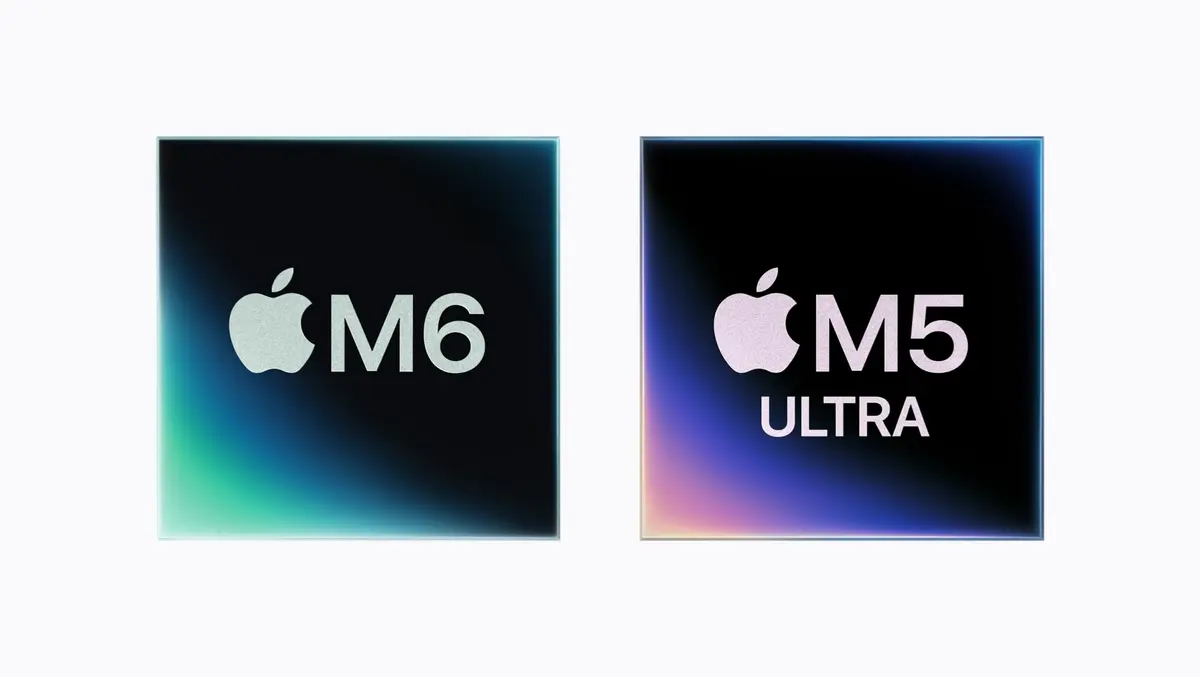
Apple unveils M6 & M5 Ultra chips for Mac desktops
Wed, 26th Aug 2026
Apple has introduced the M6 and M5 Ultra chips for its Mac desktop lineup. The M6 will ship in the new Mac mini, while the M5 Ultra will power the new Mac Studio.
The announcement extends Apple's in-house silicon strategy with a new mainstream desktop chip and a higher-end processor aimed at professional users handling demanding graphics, video, and artificial intelligence workloads.
M6 is Apple's first 2-nanometre chip, moving the Mac mini to a 12-core CPU and 12-core GPU. It also adds a dual 16-core Neural Engine and up to 170GB/s of unified memory bandwidth, according to Apple.
Apple said the M6 CPU has two more cores than the M5, with a layout of two super cores, four performance cores, and six efficiency cores. In the company's testing, the chip delivers up to 1.2 times faster multithreaded performance than M5 and up to 2.4 times faster performance than M1.
The M6 graphics processor also gains two cores over the previous generation. Apple said each GPU core now includes a Neural Accelerator, lifting peak GPU compute for AI by nearly 30 per cent compared with M5 and by more than eight times compared with M1.
M6 supports up to 32GB of unified memory. Apple said the added bandwidth is intended to support multitasking in heavier applications, as well as running large language models on the device itself.
Desktop focus
Apple is positioning the higher-end M5 Ultra for Mac Studio buyers handling 3D rendering, visual effects, scientific workloads, and larger AI models. It uses a quad-die design for the first time in an M-series system-on-chip, according to the company.
The design links two dual-die M5 Max chips through Apple's UltraFusion packaging technology. The inter-die bandwidth exceeds 4.4TB/s, allowing the four dies to operate as one processor, Apple said.
M5 Ultra scales to a 36-core CPU and an 80-core GPU. Apple said the CPU includes 12 super cores and 24 performance cores, while the GPU adds a Neural Accelerator to each core and supports newer graphics features, including mesh shading and ray tracing.
In Apple's tests, M5 Ultra provides up to 1.25 times higher single-threaded performance and up to 1.3 times higher multithreaded performance than M3 Ultra. For graphics, the chip delivers up to 40 per cent faster performance than M3 Ultra, according to the company.
One of the more significant changes is memory. Apple said M5 Ultra supports up to 512GB of unified memory and 1.2TB/s of memory bandwidth, 50 per cent higher than M3 Ultra. That local memory capacity is intended to let users keep large datasets and larger AI models on a machine without relying on remote infrastructure.
AI push
The launch also underlines Apple's effort to position its hardware for AI development and on-device inference. Both chips include updated neural processing blocks, while developer tools such as Core AI, Core ML, Metal, and Xcode can direct work across the CPU, GPU, and Neural Engine, Apple said.
For M6, Apple is emphasising a dual Neural Engine arrangement that system frameworks can use simultaneously. For M5 Ultra, it is highlighting a 32-core Neural Engine alongside the larger GPU and memory pool for users running larger models locally.
Sri Santhanam, Vice President of Silicon Engineering Group at Apple, described the launch as a step forward in the company's chip roadmap.
"Today, we're debuting the next giant leap in performance and AI compute for Apple silicon with the incredibly advanced M6 and the most powerful M-series chip yet, M5 Ultra. Built using the cutting-edge 2 nm process, M6 combines a new CPU complex, two additional CPU and GPU cores, a Dual 16-core Neural Engine, and more unified memory bandwidth to power through workloads with amazing energy efficiency. And for the ultimate desktop performance and the ability to run massive AI models, M5 Ultra features a massive GPU, now with Neural Accelerators, and more unified memory bandwidth, pushing the boundaries of what a desktop can do," said Sri Santhanam, Vice President of Silicon Engineering Group at Apple.
Broader strategy
Apple's move comes as chip suppliers and computer makers compete to show that personal computers can handle more AI tasks locally, reducing dependence on cloud services for some workloads. The company has increasingly framed memory bandwidth, neural processing, and graphics throughput as central measures for desktop systems, particularly for developers and creative professionals.
The Mac mini and Mac Studio releases also show Apple continuing to segment its chip range more sharply. M6 appears aimed at a broader desktop market, including developers, students, and general users with heavier computing needs, while M5 Ultra targets specialist buyers who need larger memory footprints, stronger graphics output, and faster processing for complex projects.
M5 Ultra also includes hardware for H.264, HEVC, ProRes encode and decode, and AV1 decode, underscoring Apple's continued focus on video production workloads in the Mac Studio line.