

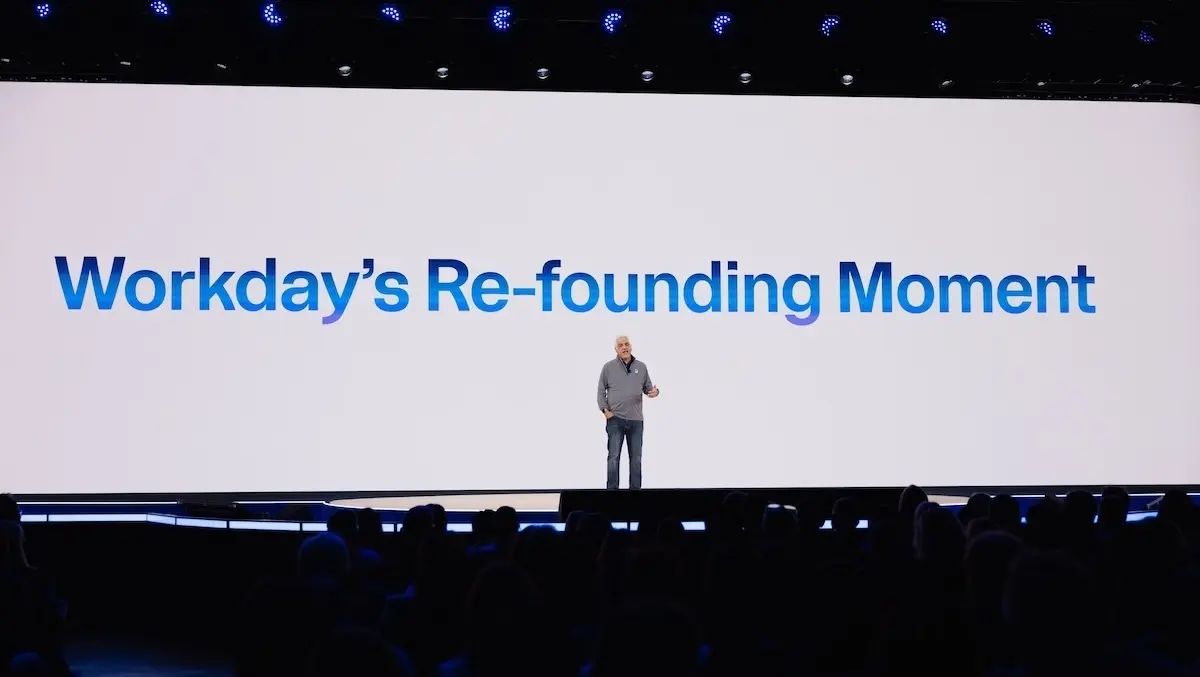
Workday is a Fortune 500 startup reborn for the AI era
Thu, 15th Oct 2026 (Today)
When Workday founder Aneel Bhusri returned to the company as CEO in February 2026, he set about transforming the company. In that time, he has effectively "refounded" the company, with an AI-led approach that delivers faster product cycles and a leaner operating model with autonomous agents embedded in HR, finance and IT workflows. And the acquisition of C1.ai brings stronger identity, security and governance around those agents.
The company's product vision has moved beyond users prompting assistants. Using Jev, a new decision model created by TypeSafe AI, Workday now has a dynamic user interface that works with the software's new homepage. At Workday Rising, the company's annual user event, Workday's President of Product and Technology, Gerrit Kazmaier. announced that Sana will be that new homepage.
Sana was acquired in 2025 and is now fully integrated into Workday. When a user starts typing a request, such as applying for leave or setting up a meeting with colleagues, the user interface uses Jev to dynamically create to help the user complete that request significantly faster than before.
The vision, Kazmaier said, moves beyond users prompting assistants. Humans will increasingly perform "meta work": creating, supervising and intervening in fleets of agents.
The recasting of the organisation since Bhusri's return has not been without some pain. There have been layoffs with Bhusri saying these were not because of AI being used more but as the result of corporate bloat.
"There were some parts of the development organisation with 10 layers between me and the developer getting work done. And it was the developers themselves who said I can't get anything done, there are too many layers of approval. I'm very sad about the folks that left the company. We did offer them individual contributor jobs. We made a very painful change, but that was not about AI," said Bhusri.
Bhusri said that part of his motivation to return to the company was that he couldn't sit on the sidelines and watch the AI transition. With very few founders returning after leaving a company, he looked at Steve Job's journey for inspiration and advice.
"I spent hours and hours that drove my team crazy with Instagram videos of Steve Jobs talking about what he did when he went back to Apple," he said. "He wasn't only a great product leader, he was an amazing management thinker and well ahead of his time. In his All Things D interview he [Jobs] talks about this mindset of returning to the startup culture. Faster decisions, less layers, best idea wins and clear lines of ownership. We've embraced a lot of that in the last nine months to get back to thinking and acting like a startup. But a startup that has a lot of customers that depend on us and a lot of employees and technology that we can leverage."
Before his return, responsibility for agents, APIs and AI initiatives was spread across multiple leaders and business units. Workday has since consolidated accountability, appointing a single owner for each of its agents, APIs and data cloud. Teams can make decisions and deliver faster.
The restructuring also supports a renewed focus on customer partnerships to help drive Workday's growth.
Bhusri does have some concerns around the rise of AI. While he doesn't believe there will be mass displacement of people as AI becomes more embedded in companies, he is concerned for the future of students and graduates entering the workforce today.
"I am worried about college grads getting jobs. I think that's going to be impacted. And that is not a good sign. We have to solve that as a society because a lot of those jobs are entry-level jobs that probably AI could do," he said.
As part of the transformation led by Bhusri, Kazmaier and the rest of the Workday leadership team the acquisitions of Sana and Paradox have been fully integrated into the Workday organisation and software. And that's set to be boosted with the acquisition of C1.ai.
"C1.ai becomes the identity governance and security enforcement layer," said Kazmaier. "It answers one of the most pressing questions in all of AI. How can you secure agents at scale?"
Alex Bovee, CEO and co-founder of C1.ai said "We have the exact same challenges we had in the human era, but now we've got it at machine scale and machine speed. That's why we've built the unified identity access governance platform for humans and agents to get the right access at the right time."
Workday's transformation is an ambitious attempt to combine the speed and focus of a startup with the scale, responsibilities and customer base of a Fortune 500 company. Bhusri's AI-first product strategy will leverage the acquisitions of Sana, Paradox and C1.ai to give the company the interface, automation and governance layers to support it. The next year will prove whether Workday can move at startup speed without losing sight of the people, customers and trust that underpin its business.