

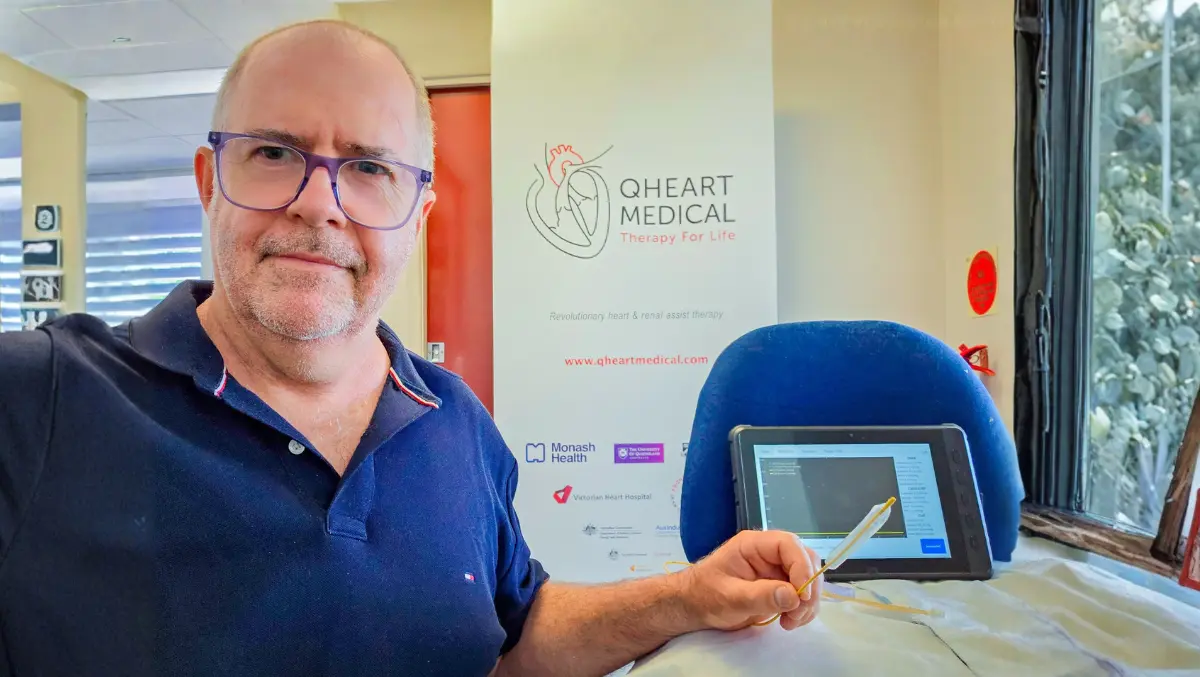
QHeart to trial pumpless heart failure device in 2026
Tue, 3rd Feb 2026
QHeart Medical has received conditional Human Research Ethics Committee approval for a first-in-human study of its pumpless heart failure device in Australia.
The Brisbane-based medtech company said the pilot study will start in early 2026 at Monash Health's Victorian Heart Hospital. Clinicians plan to evaluate QHeart's Transcatheter Aortic Recoil Repair device in patients with acute decompensated heart failure. The condition involves a sudden and severe deterioration in heart failure and often leads to emergency hospital treatment.
QHeart said heart failure ranks among Australia's most common reasons for hospital admission, with around 170 people hospitalised each day. The company cited Medical Journal of Australia data which puts 30-day re-admission rates at 24.8% for patients hospitalised with heart failure.
The same data estimated unplanned re-admissions between 2013 and 2017 cost the Australian health system AUD $604 million. QHeart said persistent congestion and kidney-related complications contributed to repeat admissions and poorer outcomes.
Device approach
QHeart said its device aims to support heart function during the hospitalisation period for acute decompensated heart failure. The company said it wants to reduce congestion and improve patient outcomes.
"The key innovation in our device is its pumpless, passive recoil design what we call Aortic Recoil Repair (ARR) technology," said Dr Peter Walsh, CEO and CTO, QHeart Medical.
"Rather than pumping for the heart, it supports the heart to pump more effectively itself," said Walsh.
"There is no external power source. It is powered entirely by the patient's own body," said Walsh.
"We believe the TARR therapy could provide clinicians with a lower-risk, earlier intervention for the fifty per cent of patients who currently have no effective treatment options," said Walsh.
QHeart described the system as a transcatheter implant that uses a passive recoil mechanism. The company also described it as a form of intra-aortic balloon therapy that does not require an external pump or power source. It said the device sits in the descending abdominal aorta and clinicians can place it via femoral or axillary artery access.
Pre-clinical data
QHeart said the ethics approval follows a multi-year development programme. It said pre-clinical testing included an induced pig model of heart failure. The company reported improvements in cardiac output and stroke volume in those studies.
Monash Health clinicians said prior work with a surgical version informed the current transcatheter project.
"In clinical studies using a surgical version of QHeart's Aortic Recoil Repair (ARR) therapy, we found clinically significant improvements in heart output in scheduled heart surgery patients," said Professor Julian Smith, Senior Cardiothoracic Surgeon, Monash Health.
"The new TARR device has performed equally well in pre-clinical studies," said Smith.
Clinical focus
The Monash Health team said the study will focus on acute heart failure patients who also present with kidney dysfunction. Clinicians often link kidney impairment with fluid overload and worsening heart function in these cases.
"Patients with acute heart failure are known to also have kidney dysfunction, which causes further congestion and worsening of heart output. This leads to reduced quality of life and higher patient mortality," said Associate Professor Robert Gooley, Head of Interventional Cardiology, Monash Health.
"If we can show the TARR to improve patients' heart output and reduce their congestion, with low risk and blood friendly use, the potential of the TARR therapy is likely to be transformative for in-hospital acute heart failure treatment," said Gooley.
QHeart said its longer-term clinical and regulatory plan includes meeting predefined endpoints in the single-site pilot study and then running a multi-site regulatory clinical trial. It also plans to seek US Food and Drug Administration clearance for manufacturing and commercialisation.
Funding plans
QHeart said competitive funding from the Australian Government's Collaborative Research Centres Projects programme supported its proof-of-concept milestone and clinical programme. It said the award was made in partnership with Monash University, Monash Health, Bion Health and The University of Queensland.
The company said it is preparing a capital raise to fund clinical trials through to FDA clearance for the TARR.