

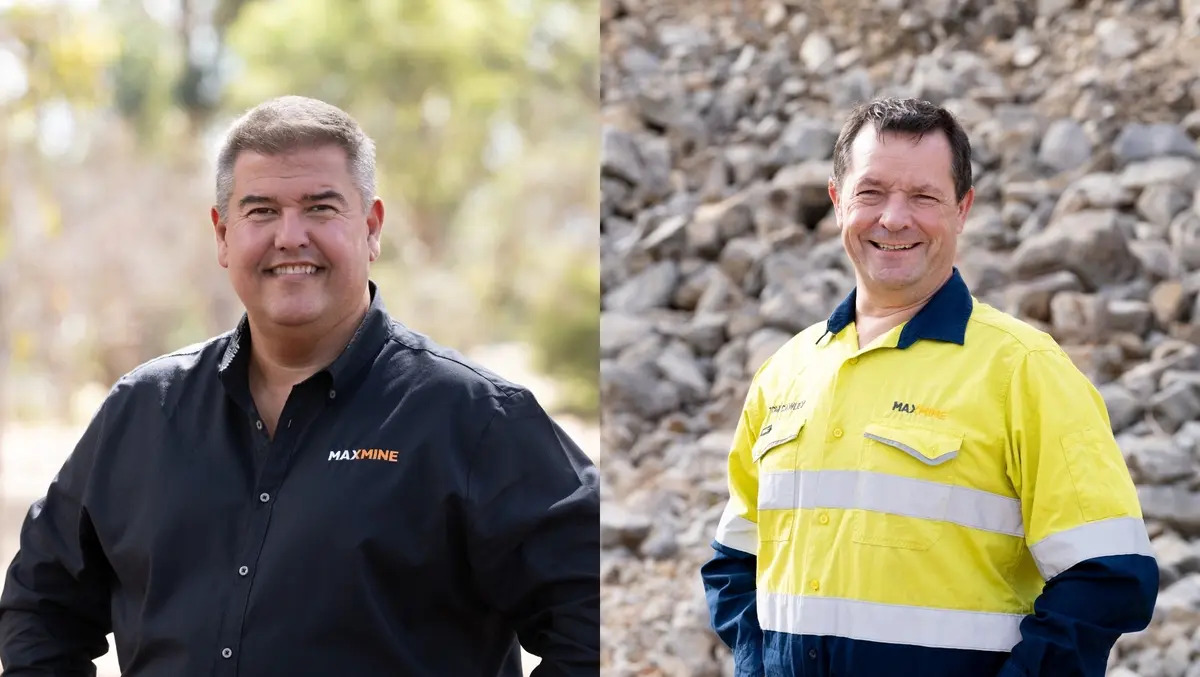
MaxMine executive takes AI role in mining sector push
Thu, 21st May 2026 (Today)
Tom Cawley has been appointed Mining Sector Lead at the AI Accelerator Cooperative Research Centre, linking MaxMine more closely to a national effort to build Australian artificial intelligence tools.
The appointment comes as MaxMine rolls out a machine learning system for load and dump classification across Australian mining customers including Glencore, NRW Holdings and Macmahon. The system has been fully operational for six months at customer sites.
The Australian mining technology company said the software was built using more than 14 million hours of labelled operational data. It is designed to automate parts of production tracking by classifying load and dump events, a process that can affect how mine output is recorded and analysed.
According to MaxMine, the system has reduced workloads for site teams by cutting missed or incorrect loads and improving production tracking accuracy, particularly in more complex operating scenarios. Its internal development process also benefited from structured data and machine learning pipelines, allowing the model to address a wide range of edge cases without custom work for each site.
AI in mining
Cawley's new role places a MaxMine executive at the centre of a broader push to expand domestic development of artificial intelligence in industry. The AI Accelerator Cooperative Research Centre was set up to help Australia build more of its own AI tools for sectors including mining, rather than relying on overseas providers.
The move reflects a wider challenge in the resources industry, where companies have invested in digital systems for years but often struggle to shift projects from trials into routine operations. Data quality, system integration and site-by-site variation have all limited broader adoption.
Shaun Mitchell, chief executive officer of MaxMine, linked the company's latest deployment to the quality of the data used to train it.
"Our successful implementation of this new machine learning system reinforces what has been observed across the industry: organisations succeeding in AI are those that have the highest-quality datasets. As AI adoption accelerates across mining and other critical industrial sectors, having high-fidelity, ground-truthed data becomes essential for delivering accurate results, improving operational visibility and enabling faster, more informed decision-making," Mitchell said.
Data quality remains central to many industrial AI projects. In mining, operating conditions vary sharply between fleets, pits and sites, making it difficult to build models that continue to perform once they move from a controlled pilot into a live production setting.
MaxMine said its latest model runs within a private environment and draws on high-resolution data across load and haul operations. That combination, it said, has allowed the model to deliver stable results across different assets and site types.
Sector push
Cawley said the industry still faces a gap between investment and practical outcomes at scale.
"Despite increasing investments in AI, industries such as mining still struggle to move beyond pilot initiatives to achieve large-scale operational outcomes. Gartner estimates that 60 per cent of AI projects fail due to a lack of AI-ready data, with 42 per cent of organisations abandoning AI initiatives before they reach production. At MaxMine, we've demonstrated that Australia has the capability to develop advanced AI tools that work effectively at scale in mining. I hope my role at the AI Accelerator CRC will encourage further innovation across the sector and help to strengthen Australia's competitive edge in the critical minerals market," Cawley said.
The reference to critical minerals highlights the strategic importance now attached to digital systems in extractive industries. Australia has sought to strengthen its position not only as a supplier of mineral resources but also as a developer of the technologies used to manage and process them.
For mining contractors and producers, classification systems serve a practical day-to-day function. Errors in load and dump records can affect reported production figures, shift analysis and reconciliation between mine plans and actual activity. Automating that work can reduce manual intervention by site teams, though adoption depends on whether operators trust the output in live conditions.
Professor Anton Van Den Hengel, chief scientist at the Australian Institute of Machine Learning and interim chief executive officer of the AI Accelerator CRC, said MaxMine's dataset had been a distinguishing factor.
"The ability for a model to be deployed with such accuracy across such a range of asset and site types is rare. MaxMine's ability to do this points to their uniquely rich, accurate and human error-free data sets, paired with long-term, multi-site, multi-machine training data sets," Van Den Hengel said.
MaxMine's customer base includes Australian operators and mining groups with international operations, among them NRW Holdings, Macmahon, First Quantum Minerals and Kinross Gold.