

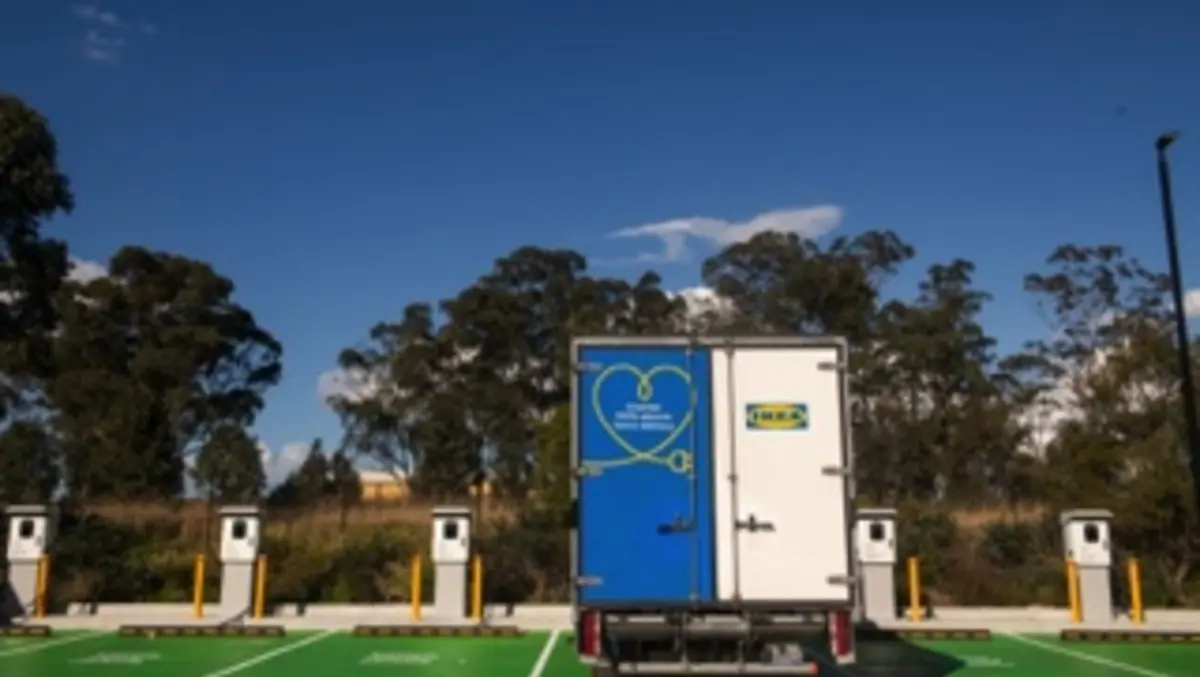
JET Charge powers IKEA's national EV delivery rollout
Wed, 7th Jan 2026
EV charging specialist JET Charge has completed one of Australia's largest electric delivery vehicle charging rollouts for IKEA Australia, installing 59 chargers across seven locations in a project aimed at shifting more of the retailer's deliveries to zero-emission vehicles.
The network supports more than 100 electric delivery vehicles that now charge at IKEA sites. The company said the rollout covers the majority of IKEA's Australian delivery network and is designed for use by third-party delivery partners as well as internal fleets.
IKEA Australia is working towards a goal of 100% zero-emission deliveries. It reported that 83% of its deliveries were completed by zero-emission vehicles in October 2025 and expects this figure to reach 90% by the end of 2025.
The project addresses a key concern in the logistics sector. Industry groups and operators have highlighted the lack of depot-based charging and grid-ready sites as a major barrier to decarbonising road freight and delivery operations across the country.
Retail logistics focus
JET Charge said the IKEA deployment shows how large retailers can install charging infrastructure at scale across complex operations and multiple locations. The company described it as a blueprint for other businesses planning to electrify commercial fleets.
"This project proves that zero-emission logistics isn't just possible - it's scalable. By building intelligent, fit-for-purpose infrastructure, we've given delivery partners the reliability they need on the road and IKEA the visibility to lead real emissions reductions across its supply chains. It's a blueprint any retailer can follow," said Tim Washington, CEO and co-founder, JET Charge.
The rollout spans sites in Tempe, Rhodes, Marsden Park, Sydney CDC, Canberra, Springvale and North Lakes. JET Charge plans implementation at IKEA's Richmond and Logan locations in the near future, which would extend the network across additional metropolitan and regional corridors.
The chargers are installed at IKEA depots and store locations. Delivery partners can access them during loading windows, overnight parking, or dedicated charging periods, depending on local site operations.
Smart load management
The project uses smart load management systems at each of the seven completed sites. The technology balances power use between chargers and the building, and manages on-site energy constraints within existing grid connections.
JET Charge said this approach reduces the need for costly grid upgrades. It also prepares the sites for higher numbers of electric vehicles over time.
The rollout also integrates a Chargefox billing platform. Third-party drivers use the system to pay for charging sessions. IKEA receives reimbursement for electricity usage through the same system.
Washington said this investment model gives delivery partners predictable access to charging and supports wider adoption of electric delivery vehicles.
"The financial investment in dedicated charging infrastructure will enable broader scale adoption of delivery vehicles by providing access for delivery drivers to recharge at sites owned by retailers and delivery companies," said Washington.
The company said uptake at IKEA sites indicates strong demand from contracted operators for on-site charging that aligns with delivery schedules and route planning.
Climate targets pressure
Decarbonising delivery fleets has become a focus for Australian retailers and logistics providers under tightening corporate emissions commitments. Policymakers and industry bodies regard electrification of vans and light trucks as a comparatively near-term route to reducing transport emissions.
Sales of electric commercial vans and trucks remain relatively small, but the available models can already meet many urban and short-haul delivery requirements. Industry analysts expect these segments to grow as more manufacturers introduce new models and as charging networks at depots and customer locations expand.
Washington said JET Charge is seeing increased interest from businesses that operate national or multi-site logistics networks, particularly where fleets undertake repeatable routes and return to base daily.
"The impact of JET Charge's rollout is showing in numbers, with more than 100 vehicles now charging at IKEA sites to enable zero emission delivery. This indicates the strong demand with third-party delivery partners and proves that investing in the infrastructure internally is extremely effective for business," said Washington.
IKEA is using the network as a core element of its delivery decarbonisation programme across Australia and New Zealand.
"Rolling out EV charging at scale is a critical step in achieving zero emission delivery. JET Charge's infrastructure and implementation of the project, which spans the majority of our Australian delivery network, is already having a significant impact. With 83% of IKEA deliveries now completed by zero-emission vehicles (October 2025), this model is helping us rapidly reduce our emissions and accelerate towards our goal of 100%. We aim to hit 90% by the end of 2025 and the last 10% when technology allows," said Alexandra Kelly, IKEA Zero Emission Delivery Project Lead, Australia and New Zealand.
JET Charge said it expects similar depot-based charging projects for other retailers and logistics operators as fleet managers move from pilot schemes to larger-scale electrification.