

Fujitsu unveils tin-vacancy diamond quantum prototype
Tue, 8th Sep 2026
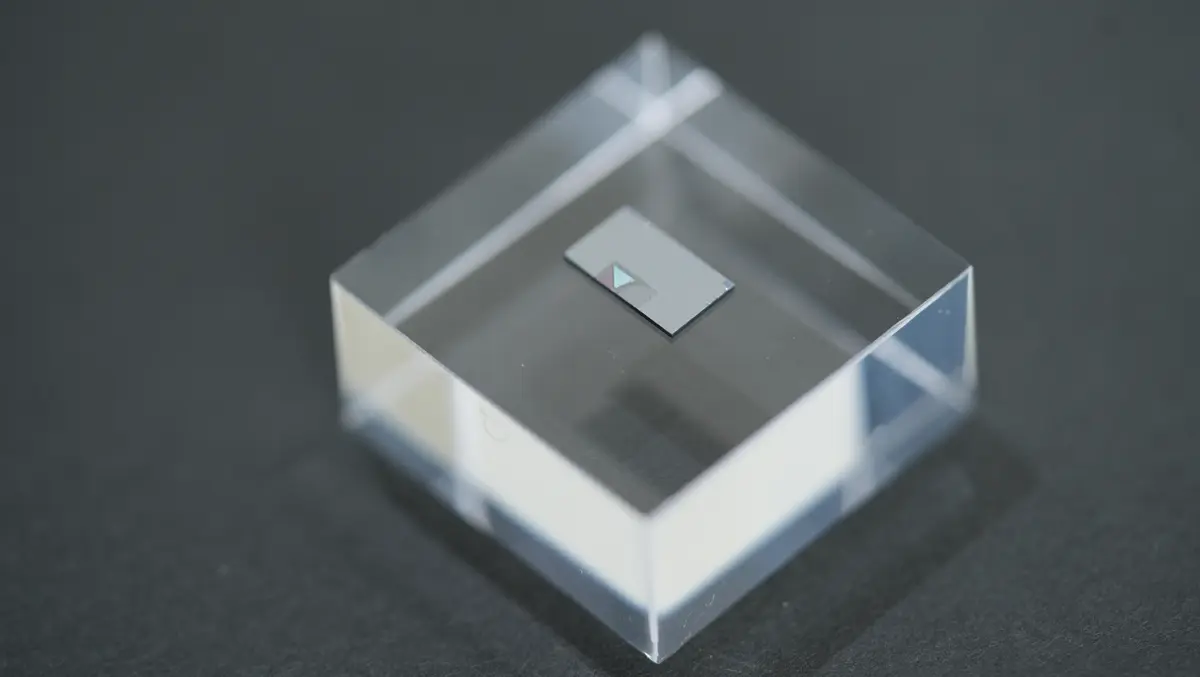
Fujitsu has developed a working prototype diamond-spin quantum computer that uses tin-vacancy centres, which it described as the first system of its kind.
The prototype uses tin-vacancy, or SnV, centres in diamond instead of the nitrogen-vacancy centres more commonly used in this area of quantum research. According to Fujitsu, the change improves qubit stability and reduces sensitivity to external noise, a limitation of earlier approaches.
Users can operate the system through Fujitsu's Hybrid Quantum Computing Platform without specialist knowledge of quantum hardware, the company said. In a test environment, the prototype was controlled through software that converts quantum circuits into the physical control sequences needed for the diamond-spin approach.
The work is another attempt to tackle one of quantum computing's central challenges: scaling systems beyond small experimental devices. Fujitsu described the prototype as a step towards a modular architecture in which smaller quantum chips can be linked together, rather than relying on a single larger processor.
That matters because modular designs are widely seen as one possible route to building larger quantum systems. In diamond-spin systems, optical links can connect separate modules, allowing qubits on different chips or in different cryogenic setups to interact.
Fujitsu said the prototype operates at -271.6°C. That is still close to absolute zero, but warmer than the -273.13°C often associated with superconducting quantum computers.
The project stems from joint research launched in 2020 with Delft University of Technology and QuTech, the Dutch quantum technology institute that is part of TU Delft. The collaboration has focused on diamond-spin computing, which uses defects in diamond crystals as qubits.
Research basis
In conventional diamond-spin work, researchers typically rely on nitrogen-vacancy centres, where nitrogen impurities and atomic vacancies create a usable quantum state. Fujitsu instead used a tin atom positioned between two adjacent vacancies in the crystal lattice, creating what is known as a tin-vacancy centre.
Fujitsu said the structure offers greater symmetry and is less susceptible to outside interference than nitrogen-vacancy centres. It also said the diamond chip in the prototype uses tin qubits that are 10 times brighter than conventional materials, improving readout stability.
To build the system, Fujitsu said it developed several supporting technologies. These include a way to bond diamond substrates implanted with tin onto alumina and silicon dioxide substrates, and a thinning process that reduced the diamond from several hundred micrometres to several hundred nanometres so it could be used in quantum chips.
It also built photonic integrated circuits that combine nanometre-scale diamond crystals containing SnV centres with alumina optical waveguides. These waveguides are used to extract single photons emitted during qubit readout, a necessary step in measuring the state of the system.
The project also involved software and control engineering. Fujitsu said diamond-spin qubits require coordinated control using light, microwaves and radio frequency waves, and that it created a method to translate standard quantum gate descriptions into the control sequences needed by the hardware.
Roadmap
Fujitsu plans to develop a prototype multi-module diamond-spin quantum computer by 2027. It also plans to begin work on ways to integrate the diamond-spin approach with superconducting systems, reflecting a broader strategy that includes more than one hardware platform.
The company has set goals of reaching a 250 logical qubit system by fiscal 2030 and a 1,000 logical qubit system by fiscal 2035. Logical qubits are a key benchmark in the industry because they represent error-corrected units that could be used in practical computation, rather than the more fragile physical qubits found in early-stage machines.
Vivek Mahajan, Corporate Executive Officer, Corporate Vice President, CTO, In Charge of System Platform at Fujitsu, said the approach could complement other quantum technologies as well as stand on its own. "The diamond-spin approach we have applied in this prototype not only offers exceptional scalability in its own right, but also has the potential to be integrated with superconducting quantum computers to further extend their capabilities, enabling more complex and large-scale computations. Under our roadmap to achieve a 250 logical qubit system by fiscal 2030 and a 1,000 logical qubit system by fiscal 2035, Fujitsu will continue advancing practical quantum computing across a broad range of areas, from software to hardware, while leveraging the key advantages of the diamond-spin approach, including high fidelity and optical connectivity," Mahajan said.
The development also has relevance for Fujitsu's work in Australia. The company said it has signed a memorandum of understanding with CSIRO and Monash University to provide Australian researchers and students with access to Fujitsu quantum systems in Japan. A separate partnership with the Australian National University is aimed at establishing a quantum research facility and building an on-site quantum computer in Canberra.
Mahesh Krishnan, Chief Technology Officer for Oceania at Fujitsu, linked the new prototype to that regional effort. "This milestone marks the world's first prototype to use tin-vacancy centres in diamond rather than nitrogen. Traditionally, the industry has relied on nitrogen-vacancy centres in diamond, but they're incredibly sensitive to outside noise. These tin qubits are far more stable and resistant to interference, which dramatically improves their coherence times and brings us much closer to a reliable, scalable quantum system. For businesses here in Australia and New Zealand, it means quantum is moving out of the lab and closer to the real world. Our goal is to help local organisations start building and testing their quantum capabilities so they're ready to scale when the technology matures," Krishnan said.
Dr Kees Eijkel, General Director of QuTech at Delft University of Technology, said: "We are delighted to announce this prototype diamond spin quantum computer as a result of the collaborative research conducted since 2020 between Fujitsu, Delft University of Technology, and QuTech. It is a major milestone in our strong collaboration. Demonstrating the scalability expected of diamond spin quantum computing remains a long and challenging journey. However, by further strengthening our collaboration with Fujitsu, we are committed to tackling this ambitious and meaningful challenge and leading the development of next-generation quantum technologies."