

Allume Energy wins top Australian Good Design Award
Fri, 9th Oct 2026 (Today)
Allume Energy's SolShare has won the 2026 Australian Good Design Award of the Year, along with the Australian Good Design Award for Sustainability.
The Melbourne company's system allows apartment residents to share electricity generated by a rooftop solar installation, addressing a longstanding barrier for multi-residential buildings.
According to Good Design Australia, SolShare directs solar energy between apartments based on immediate electricity needs. The organisation says the technology is already used in more than 10,000 apartments across three continents and has delivered 23GWh of solar energy globally.
Residents using the system have saved an average of 30 to 40 per cent on their electricity bills, it says.
Dr Brandon Gien, Chair of Good Design Australia, said the project stood out for its response to a practical problem.
"Great design starts with deeply understanding a problem and finding a better way to solve it. SolShare does exactly that," Dr Gien said.
"Millions of people live in apartments, and many have had limited access to the benefits of rooftop solar. SolShare is a clever Australian design innovation that addresses that problem in a practical way, and it is already delivering benefits at significant scale.
"The quality of this year's Award winners is exceptional. We are seeing designers, engineers and architects working in energy, healthcare, biodiversity, artificial intelligence, climate resilience, public policy and helping address some very complex social, environmental and commercial challenges.
"The projects recognised this year demonstrate the contribution that thoughtful, well-executed design can make to industry and the wider community."
The Australian Good Design Awards span 13 disciplines and more than 30 categories. This year's winners covered fields including healthcare, engineering, public policy, climate resilience, artificial intelligence and social impact.
Australian winners
Among the other major Australian winners, Frost*collective took the Best in Discipline Award for Communication Design for the Sydney Children's Hospital Placemaking & Environmental Graphics project. The work combines wayfinding, information and storytelling for children, families, carers and staff at Sydney Children's Hospital Randwick.
In Engineering Design, Flow Hive won for the Flow Super Lifter, a device designed to make hive inspections easier for beekeepers and less disruptive for bees. The design addresses the lifting involved in checking hives and aims to reduce the risk of crushing bees while hive components are moved.
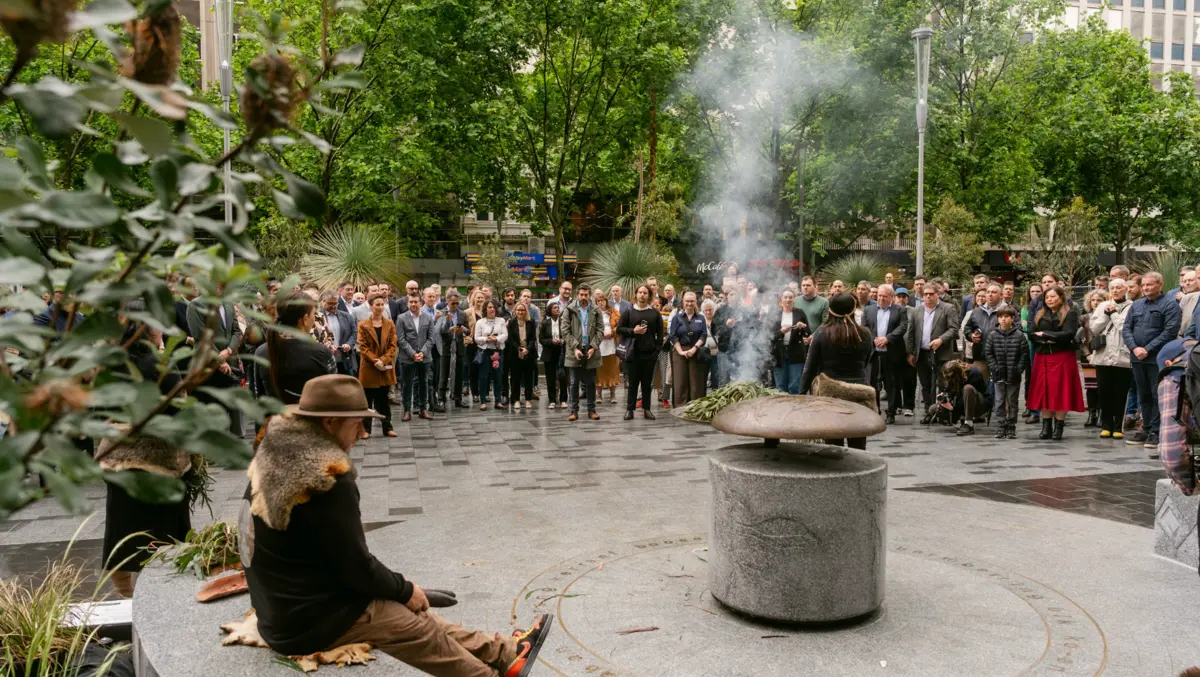
Greenshoot Consulting, working with Wurundjeri Elders, received the Best in Discipline Award for Built Environment for the City Square Ceremonial Gathering Space in Melbourne. The project was created to welcome visitors to Country, sustain Wurundjeri knowledge and cultural practices, make Woi-wurrung language visible, and acknowledge First Peoples as the Traditional Custodians of the land.
Xavier Earls won the Best in Discipline Award for Next Gen for Bush Cradle, a modular habitat system for vulnerable native animals. Made from hempcrete, the design uses four tiles that can be arranged in different ways for different species.
Policy and AI
Several winners reflected the growing role of design in policy and research, as well as physical products.
The Best in Discipline Award for Policy Design went to MAVlab at the Municipal Association of Victoria for Advancing Responsible AI Innovation in Local Government. The project developed a policy framework for AI use by Victorian local councils, including procurement guidance, a use-case library and a cross-sector taskforce.
Karla Straker received the Design Strategy Award for Designing the Intellectual Edge: A Strategy for Future Defence Learning, developed for the Australian Defence College. The project applies a design-led approach to learning for Defence personnel operating in complex environments.
ThirdStory won Best in Discipline for Design Research for Collaborative Research, Learning and Action with the DFV Specialist Support Field, commissioned by the Paul Ramsay Foundation. The project brought together 31 specialist domestic and family violence services to build shared knowledge and strengthen engagement with funders and policymakers.
International recognition
International entries also featured among the top awards. Taiwanese designer Liu Chia-Yi won the Best in Discipline Award for Concept Design for SoilRevive, an AI-based bioremediation station designed to treat farmland contaminated by heavy metals.
In Digital Design, Journey Digital of New Zealand was recognised for Te Matapihi ki te Ao Nui, Wellington Central Library, a bilingual and accessible digital entry point for the city's central library. Finnish company FabPatch won the Fashion and Textiles category for its rub-on textile repair system, designed to extend the life of garments and reduce waste.
The Best in Discipline Award for Social Impact went to the Vanuatu National Warning System: A Sovereign Digital Lifeline, designed by What Works and commissioned by SPREP. According to Good Design Australia, the system supports about 314,000 people across 83 islands by combining modern meteorology with Indigenous knowledge.
Rachel Wye, Managing Director of Good Design Australia, said the breadth of winners showed how design is being applied across the economy and public life.
"Design is an important economic and social capability. It influences the products we create, the services we rely on, the policies we develop and the way organisations respond to complex problems," Ms Wye said.
"This year's award winners are addressing energy costs, healthcare, environmental degradation, artificial intelligence, disaster preparedness, accessibility and community wellbeing.
"Australia has an extraordinary design community and an opportunity to use that capability to strengthen our economy, improve lives and build industries that can compete internationally."