

Qualcomm unveils Dragonwing IQ10 robotics reference design
Tue, 2nd Jun 2026
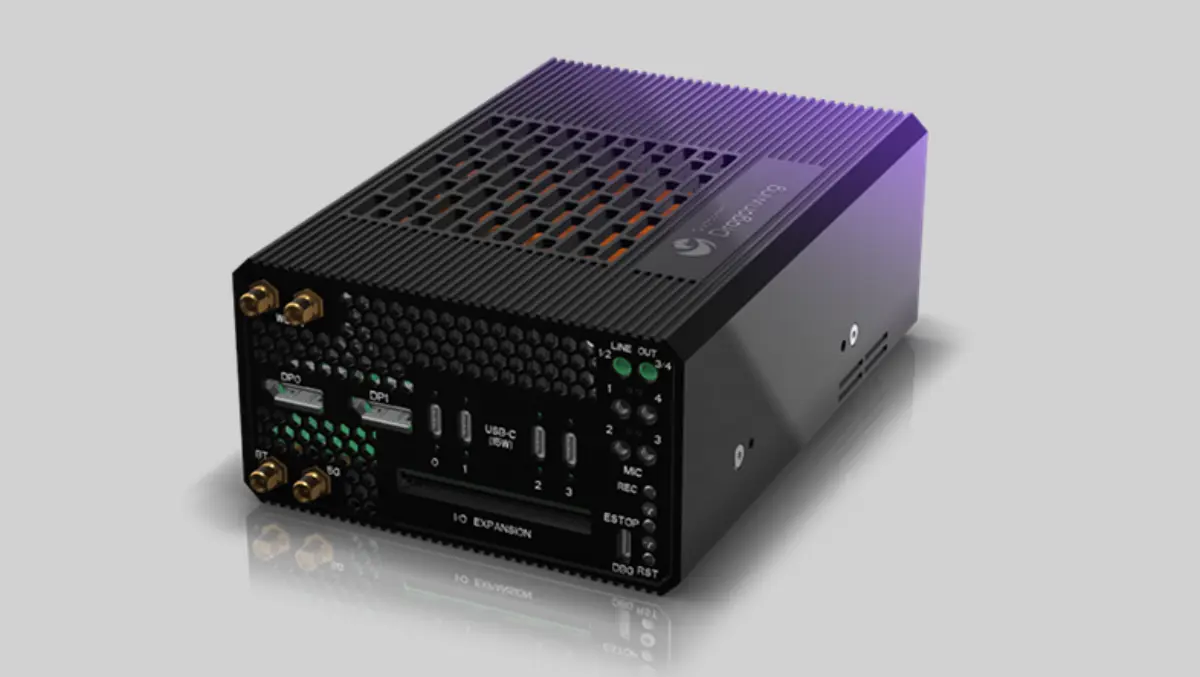
Qualcomm has introduced the Dragonwing IQ10 Robotics Reference Design, which combines hardware, software and AI tools for robotics deployment.
Built around the Dragonwing IQ10 processor, the reference design targets robotics developers working on industrial machines, autonomous mobile robots and humanoid robots. It combines compute, sensing, networking, motion control and software in a single system to help teams move from prototyping to production deployment.
The platform is designed to deliver up to 700 TOPS of AI performance. It also includes 18 Qualcomm Oryon CPU cores, multicore NPUs and a GPU configuration intended to support on-device perception, planning and reasoning without external accelerators.
Sensor support is a central part of the design. The system supports up to 12 GMSL2 cameras, along with LiDAR, Time-of-Flight, IMU and other sensors. Native sensor ingestion is designed to reduce the need for separate bridging components.
This approach is intended to keep sensor data aligned, reduce delays between sensing and processing, and simplify overall system design. The platform is built so developers can scale from camera-based systems to more complex multi-sensor robots without redesigning the underlying data pipeline.
Control and connectivity
For control and input-output functions, the reference design supports PCIe, TSN, USB and CAN, along with Ethernet, EtherCAT and CAN-FD. These interfaces are intended to provide deterministic control and consistent timing for motion systems in production robotics environments.
The enclosed system also includes forced-air cooling and is designed to operate in temperatures from -40C to 70C. It supports both 12V and 24V input, aimed at deployment scenarios where thermal margins and environmental durability are important.
Alongside the hardware, Qualcomm has packaged a layered robotics software stack with the system. This includes on-device AI runtimes, ROS2 support, platform services for sensing, planning and actuation, and cloud-connected lifecycle management through Qualcomm AI Hub.
The software stack is intended to support model development, deployment, validation and lifecycle management. Out of the box, the platform is designed for perception, navigation and localisation, planning and control, manipulation, task orchestration and natural language interaction.
Partner ecosystem
A group of early access partners is already working with the platform, including NEURA Robotics, Advantech, APLUX, Booster, Innodisk, MeiG, NEXCOM, Radxa, Thundercomm and VinMotion.
The partner list suggests Qualcomm is aiming to build an ecosystem around the reference design rather than position it as a standalone processor launch. In robotics, reference platforms can help hardware makers and software developers reduce integration work by giving them a common base for sensors, compute and control systems.
The launch comes as robotics companies look for ways to combine perception, navigation, manipulation and higher-level autonomy in machines that can operate in more complex settings. Developers increasingly have to manage not only raw computing demands but also timing, networking, safety and lifecycle management across fleets of devices.
Qualcomm said the Dragonwing IQ10 Robotics Reference Design was created to address those integration challenges through a full-stack approach. It described the system as a unified design for production-level sensor and AI systems that need modular expansion, predictable deployment and clearer validation boundaries.
That emphasis reflects a broader shift in robotics development, where the challenge is often less about adding another processor and more about combining multiple subsystems into a platform that can be tested, replicated and maintained at scale. Early access partners are already exploring the system's full capabilities.