

MSI expands target market with local AI-ready Prestige N16 Flip AI+
Mon, 9th Nov 2026 (Today)
MSI is looking to expand its presence beyond gaming laptops, positioning its latest hardware around locally processed artificial intelligence, content creation and productivity as businesses and consumers explore alternatives to cloud-based AI services.
The Taiwanese manufacturer believes the growing demand for AI-capable devices will create opportunities for laptops that can run increasingly sophisticated workloads directly on the hardware, reducing reliance on cloud computing and paid AI subscriptions.
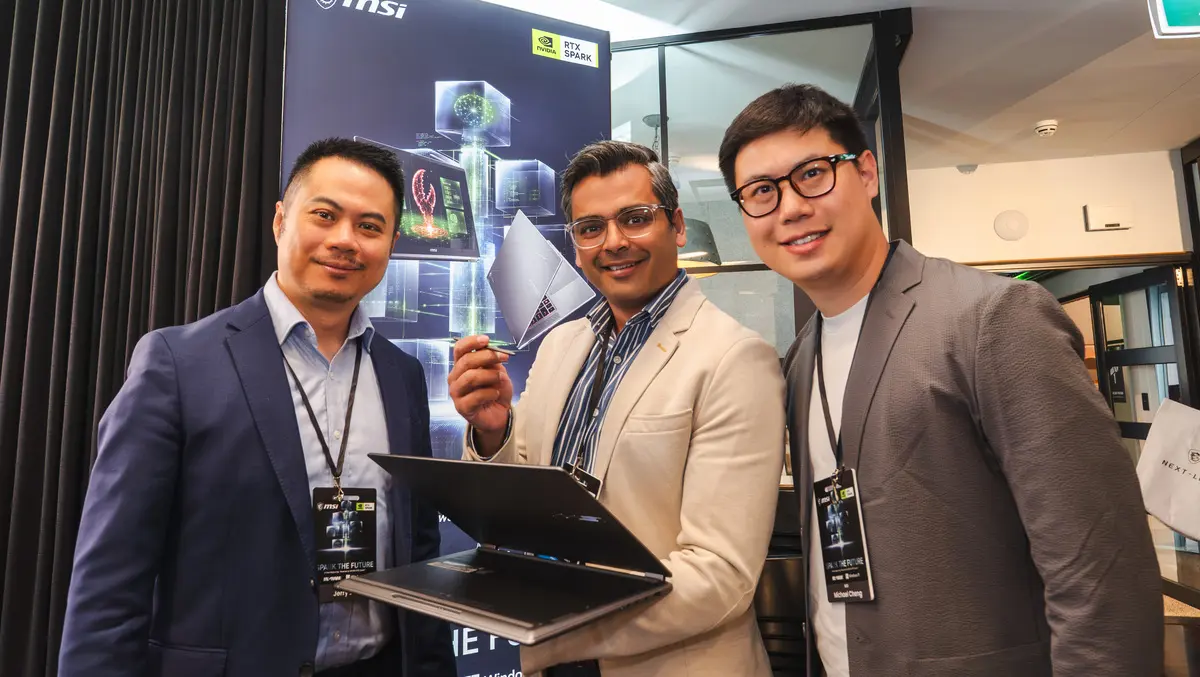
Speaking at the Prestige N16 Flip AI+ launch in Sydney, ANZ Country Manager at MSI, Jerry Lu, said it was looking to build on its gaming heritage and apply its experience in hardware engineering, design and manufacturing to a broader range of commercial and consumer devices.
"MSI is not just for gaming, but also for agentic AI," he said.
The rapid development of AI has created an opportunity for hardware manufacturers to introduce practical applications to customers, added ANZ Notebook and Handheld Team Lead at MSI, Michael Cheng.
While AI is becoming more prominent in everyday workflows for creators and professionals alike, many consumers have yet to experience its capabilities directly.
Cheng said MSI is bringing the latest technology to market and demonstrating how AI will increasingly be incorporated into everyday computing.
On-device AI processing offers privacy, cost benefits for consumers, businesses
A key feature of the Prestige N16 Flip AI+ is local AI processing, which allows the majority of applications and models to run on the laptop rather than sending data to external cloud services that are commonly based overseas.
Lu said this use case is important for users handling confidential information, including business documents and personal data, who may be reluctant to upload sensitive material to cloud-based platforms.
He expects a hybrid approach to become common.
"Eighty to 90 per cent of tasks you can finish on the local AI, and the most difficult tasks you have, you can upload to the cloud," Lu said.
Locally installed open-source models could support a range of activities, including content creation, video subtitle generation, research and organising email, Lu added.
The approach could also reduce the need for users to pay recurring subscriptions for AI services and incurring costs associated with consuming tokens.
Lu said the availability of increasingly capable open-source models meant users could access a growing range of AI functionality without necessarily relying on premium subscriptions.
However, he acknowledged that local processing would not replace cloud AI entirely.
Beefed-up hardware for AI, content creation and gaming
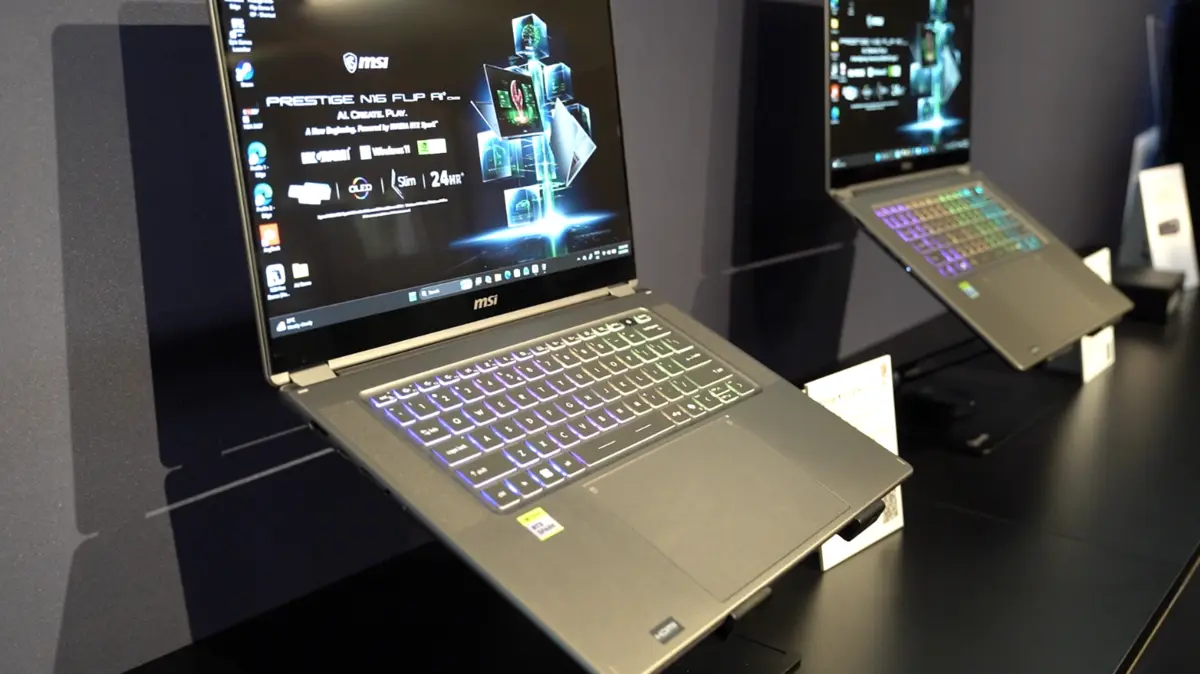
Cheng said the Prestige N16 Flip AI+ has been designed with multiple workloads in mind, including agentic AI applications, content creation and gaming.
The device's configuration includes up to 128GB of memory and 6144 CUDA cores, with its graphics capabilities providing performance beyond the level of an Nvidia GeForce RTX 5070 Ti.
He said the hardware will give users the flexibility to run AI applications while also supporting demanding creative and gaming workloads.
MSI is also expanding its target market to content creators, including video editors, photographers and YouTube creators, not limiting the device's appeal to traditional gaming customers.
Cheng said AI processing on the device could help users complete creative tasks, while the laptop's broader performance capabilities would support professional applications.
Beyond its AI capabilities, MSI highlighted a number of hardware features intended to improve the everyday user experience.
The laptop incorporates a two-in-one design, alongside an enlarged, more intuitive trackpad and noise-cancellation features.
The trackpad is designed to make everyday navigation easier, while noise cancellation will improve users' experience on Teams or Google Meet calls, with MSI recognising the move away from the traditional office environment for many Australian professionals.
The ability to combine productivity, entertainment and gaming in one device gives users greater flexibility, Cheng added.
Nvidia technology underpins Prestige N16 Flip AI+
Nvidia's RTX Spark SoC also plays a central role in the device's architecture.
It uses an ARM-based architecture and Nvidia's CUDA technology, alongside its NVLink architecture, which helps connect the CPU and GPU to support smoother operation.
He argued that the combination of technologies helped differentiate the device from conventional PC platforms and other chipset manufacturers.
The relationship between MSI and Nvidia is also significant as computer manufacturers look to develop hardware capable of supporting increasingly sophisticated AI workloads.
Running AI models locally places greater demands on memory, processing power and graphics capabilities, making the underlying hardware an important consideration for consumers and businesses evaluating AI-enabled devices.
Lu said the company's experience in gaming provided the foundation for developing the high-performance hardware required to support powerful local AI applications.
He also indicated there is a broader focus on introducing new products with improved on-device AI processing capability, with MSI planning to bring the new features to other laptops and its wider AI platform.
While the long-term adoption of locally processed AI will depend on the availability of capable models and applications, MSI believes consumers are increasingly looking for devices that can handle more workloads without depending on cloud infrastructure.
For MSI, this is intended to create a new target market, beyond its traditional gaming audience, spanning business users, creative professionals and consumers looking to incorporate AI into their everyday computing.