

Ingram Micro's Great Migration promises security and productivity boost
Fri, 7th Aug 2026
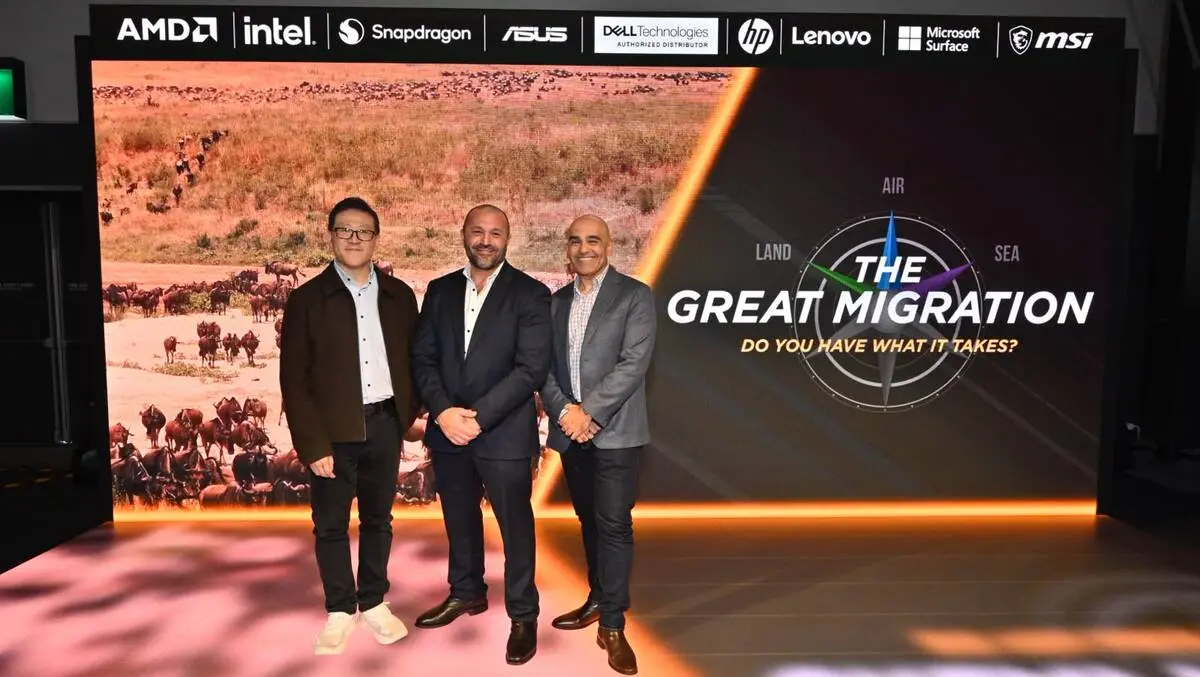
Ingram Micro has unveiled The Great Migration, a new program designed to assist partners and customers of varying maturity levels in their AI journeys.
Launched at Ingram Micro Experience in Sydney on Wednesday, the initiative has been developed in collaboration with Microsoft, supported by the likes of Intel, AMD, Dell and HP. It launches based on three key pillars for partners: cost, security and productivity benefits.
Demand for AI-ready devices has never been higher, with organisations seeking to balance improved productivity with sustainable investment. The Great Migration will also refresh millions of ageing PCs still running the now obsolete Windows 10, which presented significant security risks for companies still relying on legacy hardware and software for everyday computing.
The initiative evolved from the company's operating system refresh campaign before expanding into a broader strategy around AI adoption, according to General Manager Ingram Micro Australia, Caleb Leung.
"We took a step back and looked at customer feedback and our own data," Leung said.
Ingram Micro analysed customer purchasing patterns from February 2021 through to September 2024, deliberately excluding much of the pandemic buying period when supply shortages distorted purchasing behaviour.
The data also coincided with the arrival of Microsoft's Copilot+ PCs and a new generation of AI-enabled devices, prompting Ingram to examine how customers would transition from traditional PCs to AI-ready hardware.
"We sold well over a million PCs through our partners that weren't AI-ready," Leung explained.
"The conversation has shifted from simply talking about budgets to asking what these devices are actually going to do for an organisation's AI journey, how they help transformation and whether they'll generate a return on investment."
Instead of framing the initiative as simply a channel promotion, Leung described it as an industry-wide movement designed to help partners navigate what he believes will become a long-term shift in enterprise computing.
"It's a movement where the industry needs to embrace this together," he said.
Security overtakes cost concerns
While AI investment remains expensive, customer conversations are increasingly dominated by security concerns as organisations move beyond generative AI towards autonomous agents.
Go To Market Lead, Device Partner Sales at Microsoft ANZ, Andy Malakooti, said executives are becoming increasingly concerned about the level of autonomy they're preparing to hand over to AI systems.
"The biggest thing we're hearing from C-level executives is they're worried about the security of deploying AI," Malakooti said.
As organisations adopt agentic AI capable of accessing enterprise data and interacting with business systems, IT leaders are becoming wary of what those agents might be capable of without sufficient controls.
"They want these agents to be productive and help their staff, but they're worried. They're terrified, to be honest," Malakooti said.
Without appropriate governance, AI agents could potentially send emails, delete data or perform unauthorised actions if granted excessive permissions.
To address those concerns, Microsoft has been embedding security controls directly into Windows rather than relying solely on application-level protections.
The operating system-level controls are designed to determine what data and APIs agents can access while giving IT departments oversight over how those systems interact across an organisation.
AI PCs promise reduce long-term costs
Beyond security, AI-enabled devices could significantly reduce the operational cost of enterprise AI by processing more workloads locally rather than relying entirely on cloud services.
As organisations increase their use of cloud-based AI models, token-based pricing has become an emerging concern for CIOs managing budgets.
AI PCs could reduce cloud consumption by shifting some AI workloads onto local hardware.
"The cost of using cloud-based AI is becoming increasingly more expensive," he said.
"The Great Migration is putting AI-enabled devices into the hands of users so they can take some of that load off cloud AI consumption and reduce token costs."
Director Consumer, Client and Endpoint at Ingram Micro, Mo Kandeel, said AI-enabled hardware changes the economics of enterprise AI by allowing businesses to distribute processing between cloud infrastructure and endpoint devices.
"Historically, it's always been a hybrid AI scenario between cloud and on-premises environments, but devices weren't really part of that consideration," Kandeel said.
"Now that processing power exists on the device itself, organisations can reduce their overall total cost of ownership."
Productivity remains biggest selling point
Productivity improvement is the strongest argument for enterprise AI adoption.
Organisations taking up the initiative expect AI to reduce repetitive administrative work, while allowing employees to spend more time on higher-value tasks.
AI has already become mainstream among consumers through tools such as ChatGPT, but businesses now want AI capable of taking meaningful actions, not simply generating content.
That transition towards agentic AI, however, reinforces the need for governance and security controls before organisations deploy autonomous systems widely across their workforce.
Helping partners build AI practices
Unlike channel incentive programs focused mostly on driving hardware sales, The Great Migration is centred on helping partners develop long-term AI consulting capabilities.
Ingram Micro plans to use historical sales data to identify customer upgrade opportunities while providing technical specialists, pre-sales resources and workshops that partners can use when engaging customers.
Every reseller's customer base differs, making it difficult to prescribe industry-specific solutions from the outset.
Instead, the company intends to work alongside partners to identify practical AI use cases across industries, including healthcare, agriculture, retail, banking and legal services.
Kandeel said many traditional device-focused resellers have yet to establish dedicated AI practices and require support to make that transition.
"You've got partners that have been doing AI for years, but you've also got a lot that have historically been device-focused," he said.
"We're providing technical expertise and resources that can help them run workshops with end customers and build AI strategies."
Ultimately, The Great Migration represents a broad change to how the channel approaches enterprise technology sales.
"It's a mindset shift," Kandeel said.
"We're moving away from conversations about how much stock we can supply at a certain price and towards asking customers what outcomes they want to achieve and how we can help them get there."