

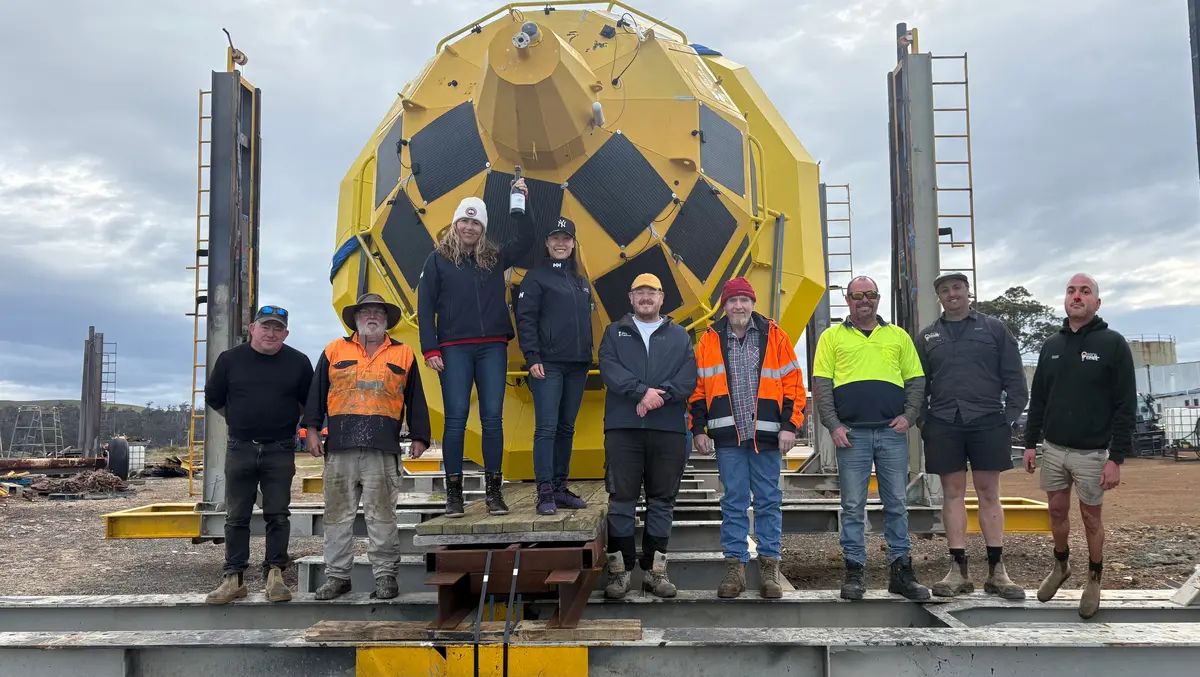
Blue Carbon oPod Aqua reaches XPRIZE water semi-finals
Wed, 27th May 2026
Blue Carbon's oPod Aqua has been named a semi-finalist in the XPRIZE Water Scarcity competition, the only Australian entry in the contest's systems and innovation category.
The Queensland company's floating desalination unit is deployed off Tasmania at Okehampton Bay near Orford. It was selected as one of 20 semi-finalists in its category from 674 teams across 86 countries competing for USD $119 million in prize funding.
The selection shines a light on a design intended to produce drinking water from seawater without a land-based plant or connection to the electricity grid. The 26-metre unit sits mostly below the surface, with a five-metre buoy-shaped structure visible above the water.
The system uses wave, solar and wind energy to draw seawater from depth and convert it into fresh water. The current prototype produces 100 litres an hour and stores more than 6,000 litres in onboard tanks.
Unlike conventional coastal desalination projects, the unit is designed to operate offshore as a self-powered pod. Leftover brine is only slightly saltier than the surrounding seawater and is diluted in open water, while upwelling flows from the pod help disperse the discharge.
How it works
The technology is part of a broader portfolio of ocean-based systems being developed by Blue Carbon, co-founded by Dr Ana Novak and Eva Chiu. The company is developing next-generation versions that could produce between 20,000 and 50,000 litres a day from a single unit by replacing electric pumps with wave-driven flow.
The XPRIZE Water Scarcity competition aims to expand access to clean water through seawater desalination systems that are reliable, affordable and environmentally sustainable. Organisers require entrants to demonstrate that their designs can operate in real-world conditions, not just in laboratories.
The recognition adds to a run of recent awards for Blue Carbon. The business was named among Queensland's leading innovators in the Brisbane Lord Mayor's Business Awards and also won both the main prize and people's choice award in the KPMG Nature Positive Challenge.
Dr Novak said the system is built around a mechanical approach.
"At the heart of the system is Blue Carbon's passive fluidic logic - a mechanical computer that removes the need for complex sensors and controls," said Dr Ana Novak, chief executive officer of Blue Carbon.
"With fewer moving parts, it's more durable, easier to maintain and lowers the cost of water."
Australian field
Australia has three semi-finalists in the wider competition. Blue Carbon is the only local contender in systems and innovation, while two other Australian semi-finalists are competing in the novel materials and method category.
The deployment off Tasmania drew on support from marine and electrical contractors involved in placing and preparing the pod in open water. Dr Novak highlighted that work in comments accompanying the announcement.
"We acknowledge the outstanding contributions of the team supporting the oPod's deployment. Their expertise, commitment and hands-on support have been instrumental to the project's success.
"This includes the teams from BLW Marine Management, Rock Electrical & Solar, Marine Solutions and West Marine, whose efforts and collaboration were critical in making the deployment possible.
"Blue Carbon also extends its appreciation to all supporting crew and contractors whose dedication and collaboration helped make the deployment a success," she said.
The competition is run by XPRIZE, which uses large-scale prize challenges to encourage technical responses to major global problems. In this case, the focus is on desalination methods that can widen access to safe water without depending on fragile infrastructure or causing environmental harm.
For Blue Carbon, the semi-final berth gives international visibility to an Australian offshore desalination concept now being tested in coastal waters south of the mainland, where a pendulum-shaped pod is producing fresh water from the sea.