

PT Blink urges tech adoption to meet Australia's housing target
Mon, 29th Sep 2025
PT Blink has stated that Australia will not meet its national housing target of 1.2 million new homes in five years without a significant shift towards technology-led building methods.
Recent data from Quantify Strategic Insights indicates building approvals dropped to 186,000 dwellings in the 2024-2025 financial year, which falls short by 54,000 homes of the government's annual goal of 240,000. While approvals for owner-occupiers rose to 119,000, local investor participation has almost halved, overseas investment has decreased, and the build-to-rent sector contributed 4,000 approvals.
Wayne Larsen, Chief Executive Officer at PT Blink, highlighted the shortfall in construction capacity under current methods. He said, "The maths don't stack up under the current model. Traditional construction simply cannot deliver 240,000 new dwellings per year. We don't have the labour, we don't have the time, and we don't have the supply chain resilience. Technology is the only way forward."
Technology in construction
The company's platform, described as "design-manufacture-integrate", utilises digital twin technology to enhance efficiency in building projects. This method diverges from traditional construction practices by producing every component offsite with precision manufacturing, before assembling them onsite as a system of parts.
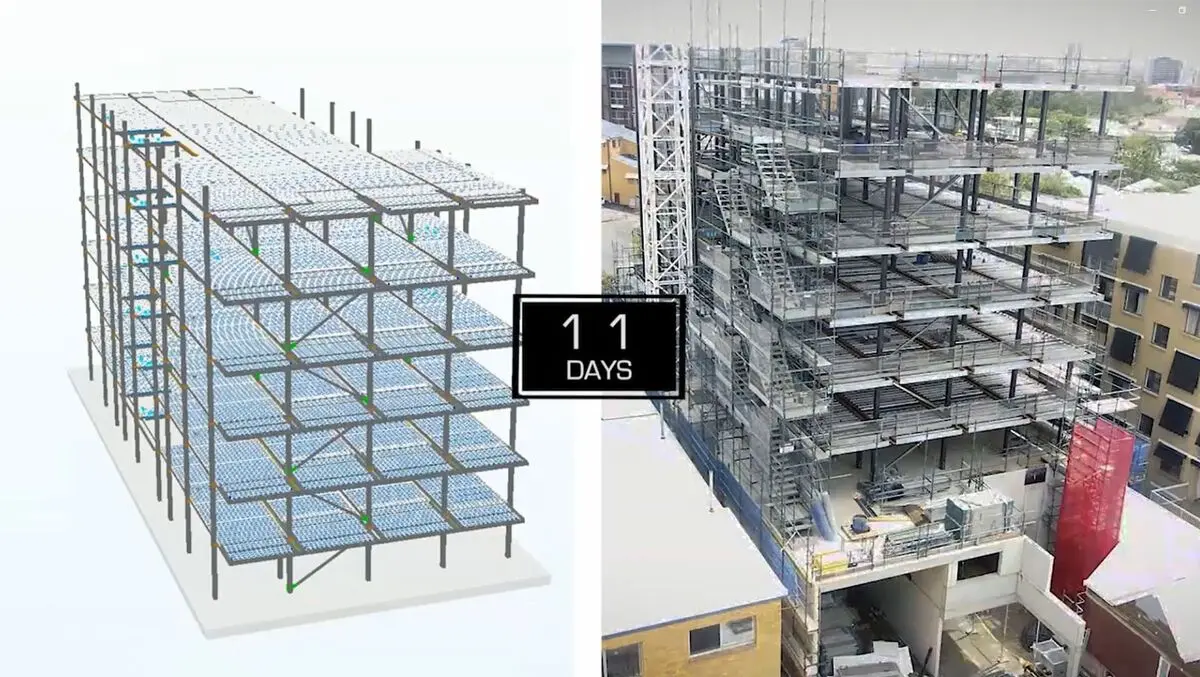
PT Blink's approach has been deployed on a mid-rise residential building in Spring Hill, Queensland, where it delivered an eight-storey apartment building in eight and a half months-half the typical duration for such a project. The main structure was put up in eleven days by a team of five, compared with the approximately sixteen months and much larger teams required by conventional methods.
"Our platform allows projects to be designed digitally, procured in real time, and assembled twice as fast with far less waste," Larsen said. "That translates into more homes delivered, greater cost certainty, and the transparency governments are crying out for."
Focus on time and economic impact
PT Blink founder Murray Ellen pointed to the importance of time in property development and its impact on affordability and the economy.
"Time is the most undervalued commodity in the property industry," Ellen said. "If you can deliver a building in half the time, the developer's return effectively doubles, and governments can roll capital over faster to fund the next project. That's how you start to close the supply gap."
Ellen also suggested the platform could support Australian industry beyond construction. "By converting even 5-10% of multi-storey buildings from concrete to steel frame, you create an entirely new market for Australian steel," he said. "At the same time, you're fixing housing affordability through faster, more efficient delivery."
Manufacturing, job creation and waste reduction
PT Blink's management asserts that its model can deliver broader economic and social benefits including job creation and environmental improvements. Each apartment constructed using the platform accounts for 1.5 full-time jobs in manufacturing, supporting local industry and, according to the company, providing career pathways for women in construction.
The company claims digital twin technology improves transparency by enabling real-time oversight for both developers and governments, aiming to reduce risks related to defects and cost overruns. Offsite fabrication is also credited with reducing construction waste, which makes up an estimated 60% of landfill in Australia.
Call to action for policy makers
With the national housing target set at 1.2 million new homes within five years, PT Blink has called on the government to consider a technological transformation in the construction sector.
"Australia needs more than incremental tweaks - we need a step change," said Larsen. "This is Australian technology, born and bred, that creates jobs, cuts build times, and delivers better homes. The government can't hit its targets without embracing it."