

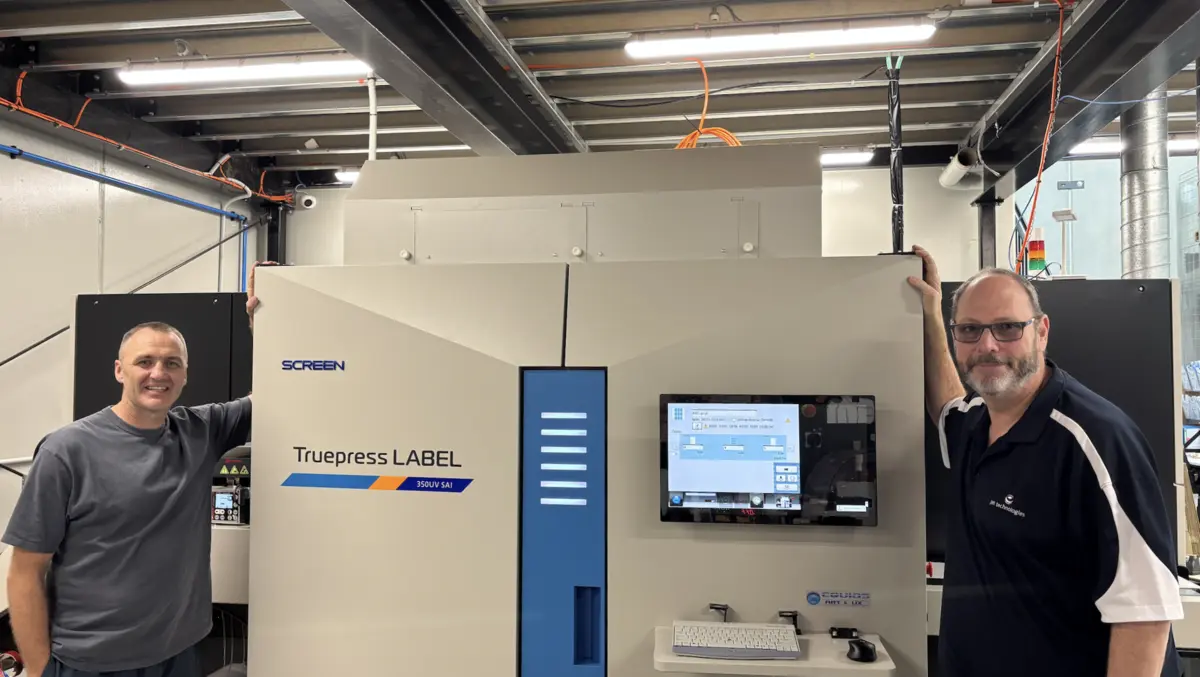
PDQ Labels doubles digital inkjet capacity with Screen press
Thu, 19th Mar 2026
Jet Technologies has completed the installation of a second Screen Truepress Jet L350UV SAI at PDQ Labels, making PDQ the first label converter in Australia and New Zealand to operate two of the digital presses.
The additional press increases PDQ's inkjet output capacity and is the next step in its digital production strategy. PDQ installed its first Screen L350 in 2021 and has since shifted more work to digital to support shorter runs and more product variants.
Across the region, label converters have been adapting as brands order smaller batches and introduce more stock keeping units. These shifts have increased job changeovers and reduced average run lengths, making traditional flexographic workflows less efficient for some work-particularly when multiple versions of similar packaging must be produced to tight deadlines.
"Since installing our first Screen a number of years ago we have noticed a massive shift in how people are ordering and the limitations that flexo was putting on us," said Paul Bentham, Managing Director, PDQ Labels. "Customers are increasingly working with a just-in-time approach and don't want to worry about how artwork changes will affect plate costs."
Flexographic printing remains widely used for long-run adhesive labels and some wide web packaging applications. However, it requires plates for each design, adding set-up steps and cost. Changeovers between versions can also create downtime and material waste, particularly when many variations run back-to-back.
The Screen Truepress Jet L350UV SAI uses a plate-free digital workflow, printing with UV inkjet and supporting inline variable data printing. Jet Technologies reports speeds of up to 60 metres per minute, depending on configuration and job requirements.
Shift in orders
PDQ said the biggest change in its order profile has been an increase in multi-variant work, where a single product range may involve dozens of versions. In these jobs, artwork and data can change frequently across the same label format. The pattern reflects brand owners testing new products, running seasonal promotions, and responding to more fragmented retail and eCommerce channels.
PDQ regularly produces jobs with 40 to 50 product variations in the same format. Under a flexographic model, each changeover can result in five to 15 minutes of downtime and additional substrate waste. Running two digital presses side by side reduces reliance on stop-start production for this type of work.
Darryl Wilson, Print & Finishing Product Manager at Jet Technologies, said the investment reflects a broader shift in label manufacturing, with digital presses increasingly taking on work that once defaulted to conventional processes.
"Ten years ago, running a 10,000-metre job digitally would have been unconventional. Today, for much of the label market, it's standard practice," Wilson said. "The addition of a second Screen L350 positions PDQ to be at the forefront of this change and a market leader in the digital label shift."
Production mix
PDQ said the second press more than doubles its digital output per shift. It also expands the range of work expected to move through its digital platform, including applications in flow wrap, shrink sleeves, and other flexible packaging formats.
As brands increase the number of versions they expect converters to manage, repeatability and consistent colour across frequent reruns have become more important, along with reliable turnaround when artwork is updated at short notice. Converters are also facing greater scrutiny over substrate waste and the cost of unplanned downtime.
The investment signals PDQ's expectation of continued growth in short- to mid-volume work, where set-up time and changeover efficiency shape profitability. It also suggests digital will take a larger share of production hours as SKU proliferation continues.
"By investing in next-generation UV inkjet technology, we're strengthening our ability to deliver predictable, high-quality label production at scale," Bentham said.
Jet Technologies Director Jack Malki said the installation shows digital inkjet has moved from a complementary role into mainstream production in many label plants.
"Digital inkjet has moved beyond being an alternative to flexo. For many converters, it is now the production backbone," Malki said. "As SKU complexity increases and lead times tighten, advanced inkjet provides the consistency, speed and flexibility required to compete."
Jet Technologies imports and distributes equipment and materials for industrial customers across Australia, New Zealand, and parts of South-East Asia. It operates demonstration centres in Sydney and Melbourne and supplies products to the print and packaging sectors.
With the second Screen press now in operation, PDQ said it is scaling a digital production model built around faster changeovers and higher volumes of multi-SKU work.