

Drakong launches Challenger controller for Xbox & PC
Mon, 13th Jul 2026.webp)
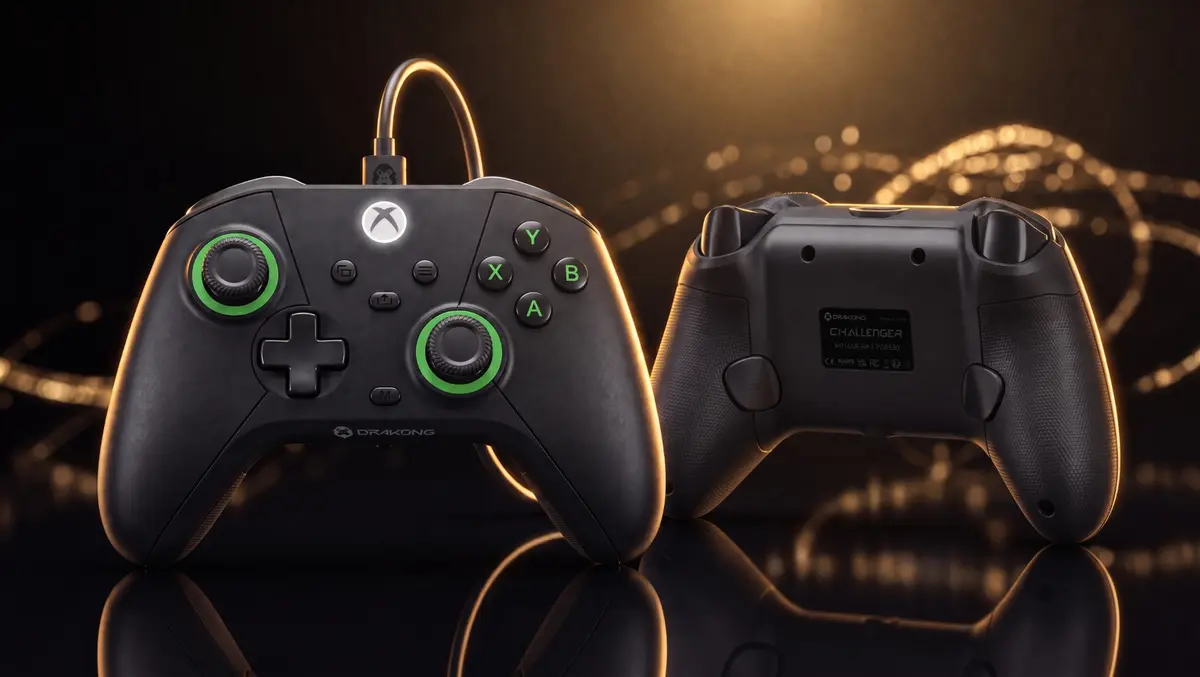
Drakong has released its first games controller, The Challenger, for Xbox consoles and Windows PCs.
The launch is the debut product from Drakong, a brand created by Hyperkin, which is known for video game accessories.
The controller is officially licensed for Xbox Series X|S, Xbox One, and Windows 10 and 11 PCs. It is priced at USD $34.99, GBP £29.99, and EUR €34.99.
The Challenger enters a crowded controller market, where manufacturers are trying to add extra features without crossing into the higher price brackets often associated with specialist gaming accessories.
Its hardware includes Hall-effect switches for the dual thumbsticks, intended to address stick drift, and twin programmable back buttons for custom inputs. The pad also includes impulse triggers, a 3.5mm headphone jack, and a detachable 10ft USB-C cable.
Drakong said it designed the controller for extended play, with laser-textured grips on the handles and triggers, as well as a membrane for the ABXY buttons intended to improve durability.
Brand debut
The release is the first commercial test for Drakong as a standalone label. Hyperkin founded the brand in 2025 as a newer line focused on modern gaming peripherals, while continuing to trade on its longer history in console accessories.
That relationship gives Drakong a route into a market where licensing and retail presence remain important, especially for products tied to major console platforms such as Xbox. Official compatibility can help newer brands stand out in a sector where buyers are often wary of lower-cost third-party devices.
Slade Dude Suzuki, Lead Product Developer at Drakong, outlined the thinking behind the launch.
"As Drakong's very first controller, we knew The Challenger needed to be something special. Representing the brand's values of innovation, craftsmanship and pioneering design, we didn't want advanced features to be locked behind an expensive price barrier, so we're proud to offer a controller that's built for everyone to enjoy. With Impulse Triggers, Hall-Effect Switches and durable membrane buttons, we've pulled out all the stops for The Challenger and we're excited to get it into the hands of Xbox and PC gamers alike," said Slade Dude Suzuki, Lead Product Developer at Drakong.
Competitive segment
Controllers have become an increasingly contested part of the games hardware market, with buyers paying closer attention to reliability, ergonomics, and latency. Hall-effect thumbsticks in particular have gained traction as manufacturers seek to differentiate products on durability as well as feel.
At the same time, premium controllers from console makers and specialist accessory brands can sell for several times the price of standard wired pads. That has opened room for mid-market and budget-focused entrants offering features once reserved for more expensive devices.
The Challenger is a wired controller, a category that still has a clear role for players who prefer not to manage battery life and for competitive users who want a stable connection. The 10ft cable suggests Drakong is also targeting living-room console play rather than only desk-based PC gaming.
The inclusion of programmable back buttons points to demand from players who want more input options without moving to a more expensive pro-style controller. Likewise, impulse triggers and a headset jack align the product closely with familiar Xbox design expectations.
Market positioning
Drakong describes itself as a gaming hardware brand founded by Hyperkin, with a focus on modern peripherals. It is trying to distinguish that identity from Hyperkin's established profile in accessories linked to classic and retro gaming hardware.
For new hardware brands, entry-level pricing can broaden appeal, but it also increases pressure on margins and product support. In that context, official Xbox licensing may be one of the more important parts of the launch, as it offers compatibility assurance and a degree of credibility that can be difficult for new labels to establish.
The release also shows how accessory makers are segmenting their product lines more narrowly. Rather than relying on one corporate brand to serve all customers, companies are creating separate labels aimed at distinct audiences, including retro enthusiasts, mainstream console players, and buyers looking for lower-cost alternatives to first-party hardware.
Whether The Challenger gains traction will depend on consumer response to its build quality and reliability as much as its specification sheet. In the controller market, reputation tends to be shaped over time by wear, responsiveness, and consistency rather than by launch claims alone.