

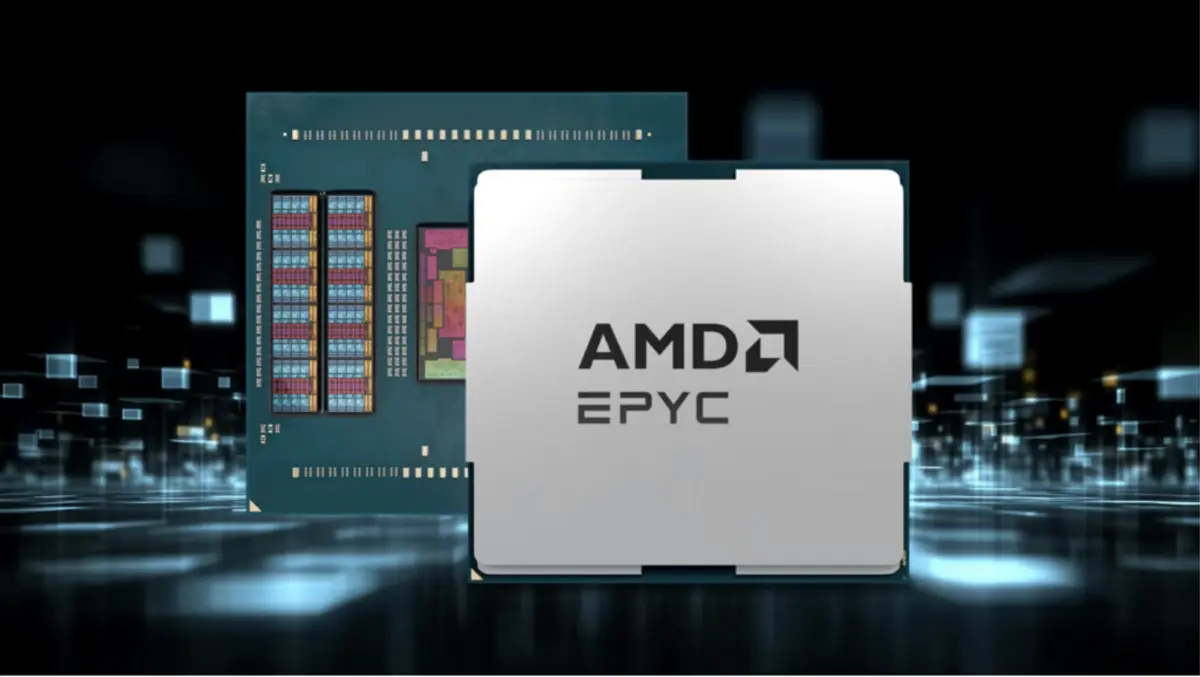
AMD EPYC chips gain ground across major cloud giants
Wed, 28th Jan 2026
AMD said major cloud providers expanded their use of its EPYC server CPUs during 2025, with new virtual machine instances and services across general compute, databases, high-performance computing and AI-related workloads.
The company pointed to additions from Amazon Web Services, Microsoft Azure, Google Cloud and Oracle Cloud Infrastructure. It described the activity as part of its effort to grow server CPU market share.
AMD also cited a statement from Amazon about performance of EPYC-based instances on AWS.
"EPYC CPU-based instances deliver the highest x86 performance in the AWS cloud," said Amazon.
AWS Instances
AWS has offered EPYC-based instances since 2018. AMD said AWS expanded its portfolio in 2025 with new offerings based on 5th Gen AMD EPYC CPUs.
AMD highlighted several EC2 families. It said EC2 C8a instances increased memory bandwidth by 33% versus the prior generation. It said EC2 X8aedz provided double the compute performance over 2nd generation Intel Xeon-based x2iezn instances.
AMD said the X8aedz line targeted electronic design automation workloads. It also referenced shorter design cycles.
AMD said other EPYC-based instances introduced or expanded during the year included EC2 R8a, EC2 Hpc8a and EC2 M8a. It described R8a as memory optimised. It described Hpc8a as focused on high-performance computing. It described M8a as general purpose.
The company said the new instance families reflected instance shapes tuned for large-scale operations. It also linked the new families to shifts of performance workloads from on-premises environments to AWS.
Google Cloud
AMD said Google Cloud adopted 5th Gen AMD EPYC processors for a set of virtual machine families. It listed C4D, N4D, H4D and G4.
AMD said the VM families target a range of workloads, including web and enterprise applications, AI and high-performance computing. It also referenced cost and scaling characteristics.
For the C4D family, AMD cited up to 80% higher web server throughput versus the previous generation and referenced a confidential computing option. For the N4D family, AMD cited up to 3.5x the price-performance on web-serving workloads compared with the prior generation N2D, and it referenced custom VM shapes.
AMD also cited figures for H4D HPC VMs from Google testing. It said the VMs deliver more than 12,000 gflops of whole-node performance and over 950 GB/s of memory bandwidth for technical computing workloads.
Azure Portfolio
AMD said Microsoft Azure broadened its EPYC CPU-based services with several VM families. It listed Dasv7, Easv7 and Fasv7 VM families. It cited up to 130% generational improvement on web server application performance.
For high-performance computing, AMD referenced the HBv5 VM. It cited 6.6 TB/s of memory bandwidth.
AMD said Azure also introduced storage optimised Laosv4 and Lasv4 VM families. It referenced low-latency local NVMe storage for data-heavy workloads.
AMD also referenced NVads V710 v5 GPU-accelerated VMs for graphics-intensive workloads. It said Azure expanded confidential computing offerings with DCasv6 and ECasv6 confidential VMs.
AMD described confidential computing as isolation for AI models, data and workloads in hardware-based trusted execution environments with encrypted and integrity-protected memory. It referenced AMD Secure Encrypted Virtualization and said the technology keeps proprietary AI models and sensitive data protected while in use.
AMD also said Azure introduced Microsoft SQL Server 2025 running on AMD EPYC processors. It linked the announcement to database performance at scale and efficiency.
Oracle Services
AMD said Oracle Cloud Infrastructure used EPYC processors in its cloud services for large-scale enterprise workloads. It highlighted E6 virtual machine and bare metal instances based on 5th Gen AMD EPYC processors.
AMD said the E6 instances provide a foundation for distributed workloads. It referenced faster processing, scalability and efficiency. It also said the approach did not require architectural changes.
AMD also pointed to Oracle Flex VM shapes. It said the option allows customers to select amounts of compute and memory as workloads scale.
AMD said Oracle Exadata Database Service and Oracle Autonomous Database run on 5th Gen EPYC. It said the services support modernisation of core database platforms across on-premises data centres, Oracle's cloud and other major clouds.
AMD said Oracle aligned compute and database infrastructure on a common AMD architecture. It described the result as a unified platform for data-intensive enterprise operations.
Outlook
AMD said it expects more growth in 2026 and beyond across the cloud providers it cited. It linked demand for EPYC to AI and HPC, large-scale analytics, software as a service and confidential computing.
The company said it continues to increase its server CPU market share since its re-entry into the market in 2017.