

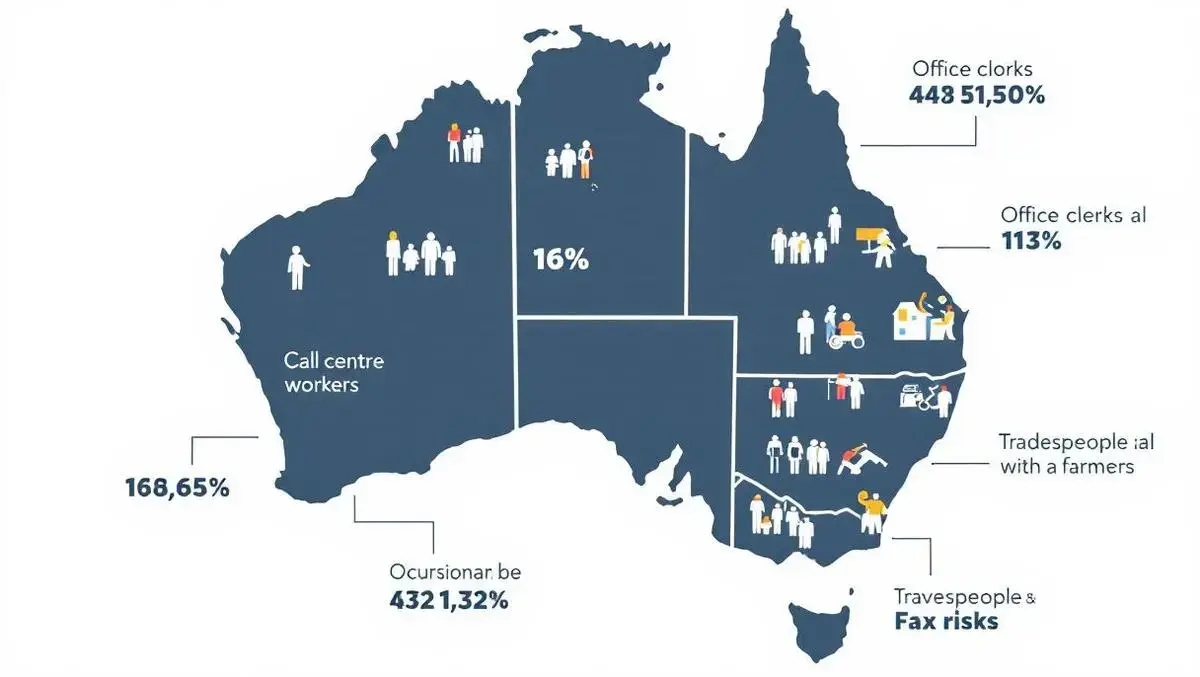
Australia map shows AI risk for clerks & telemarketers
Thu, 9th Apr 2026
Integral Media has launched Future Work AU, an interactive map of Australian occupations that scores their exposure to artificial intelligence. It covers 358 occupations across a workforce of almost 14 million people.
The tool assigns each occupation a score from one to nine, with higher scores indicating that more tasks in a role could be automated. Data behind the map shows that eight occupations, representing 417,000 workers, face the highest risk of displacement, including clerks, telemarketers and contact centre workers.
At the other end of the scale, lower-risk roles include construction workers, crop managers and school principals. The map also suggests doctors, engineers and scientists are among the occupations where AI is more likely to assist existing work than replace it.
The scoring model combines four input sets: Australian Government employment and education data, a government study on generative AI and job tasks, live job listings from SEEK, and separate assessments from Claude, GPT, Gemini and Grok.
To reduce the impact of any single model, Future Work AU uses the median score from the four AI systems rather than an average. Each occupation entry also includes a written explanation, examples of AI tools already in use, and citations from sources including McKinsey, Morgan Stanley, Deloitte and the CSIRO.
The government employment layer draws on figures from Jobs and Skills Australia and the Australian Bureau of Statistics, including pay levels, qualification profiles and five-year outlooks for 358 occupations. The live jobs component covers the 99 largest occupations by employment, accounting for 72% of the workforce.
That jobs data also points to a broader shift in hiring language: 14% of Australian job advertisements now mention AI in the job description, compared with virtually none two years ago.
Alex Morrison, managing director at Integral Media, said the project was built around local labour market data rather than overseas assumptions.
"Four independent data layers from the last six months have been used to ensure robust results for current workers, and of course, the nation's future workforce. All 358 occupations include independent citations from industry sources for cross-verification," Morrison said.
The dataset presents a more mixed picture than broad predictions of job loss. It indicates that AI enhances more tasks than it automates in 349 of 357 occupations, suggesting the technology is more likely to change task mix and workflows across much of the labour market than remove entire roles outright.
"The data tells a more nuanced story than 'AI takes all jobs'. In 349 of 357 occupations, AI enhances more tasks than it automates. So, while it shows what AI can replace, importantly, the results also show how AI can help people do their jobs better and support their business. In fact, 14% of Australian job advertisements now mention AI in the actual position description. Two years ago, virtually no jobs mentioned AI," Morrison said.
Australian context
Future Work AU places Australia's median workforce AI exposure score at 3/10. It links that lower midpoint, compared with economies such as the United States, to the country's larger share of trade, mining and other physically oriented work.
Even so, lower exposure does not mean no change. Some trade and agricultural occupations already use AI tools in day-to-day work, including crop monitoring in farming.
"Australia has a median AI exposure in the workforce of 3/10 largely compared to countries like the United States due to our trade-heavy, mining rich economy which requires more physical jobs. However, many of these trade roles are using AI to assist their professions. For example, Queensland farmers are using AI to monitor their crops," Morrison said.
Method and use
Future Work AU says the data was validated by matching 99.7% of occupations against the Australian Government's own AI study. It also says no single data source determines the final score, and users can review source data, model scores and methodological limits for each occupation.
The map is intended for workers, jobseekers and employers assessing skills, hiring and career moves. It also provides employment growth information alongside the AI exposure score for each occupation.
"Aside from general information, the map can provide interesting data for consumers on upskilling or possible career changes, growth areas of employment and general recruitment considerations. It is a one-stop shop," Morrison said.